
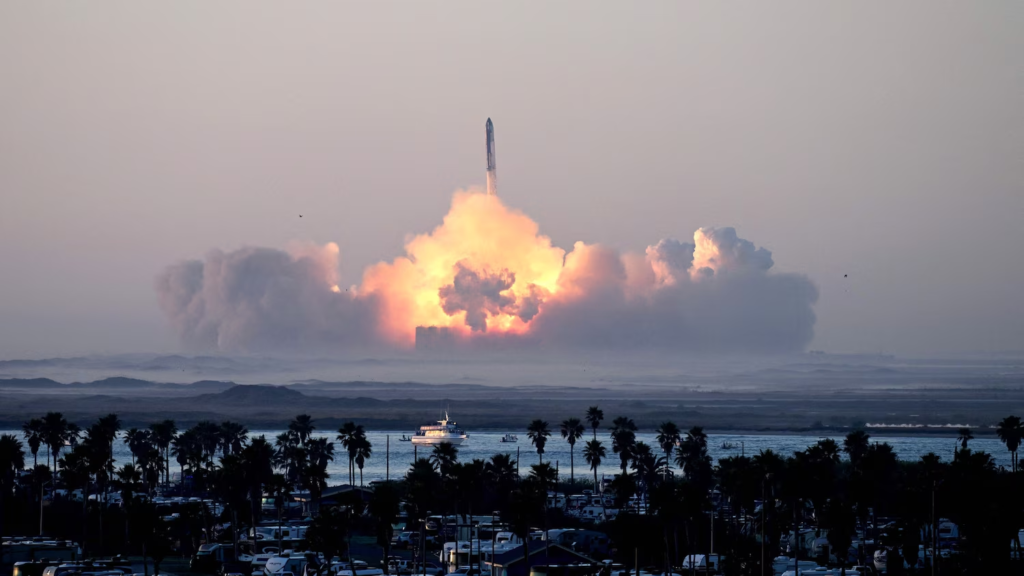
SpaceX’s mega Starship rocket achieved a significant milestone on Thursday, completing its first full test flight by returning to Earth without exploding after launching from Texas. This event has generated considerable excitement and marked the fourth launch of the world’s biggest and most powerful rocket, standing nearly 400 feet (121 meters) tall. The previous three flight demonstrations had ended in explosions, but this time, the rocket and spacecraft managed to splash down in a controlled fashion, making the hour-long flight the longest and most successful yet.
Elon Musk, CEO of SpaceX, shared his excitement on X, noting that despite losing many tiles and having a damaged flap, Starship made it all the way to a soft landing in the ocean. The Starship was empty during this test flight as it soared above the Gulf of Mexico and headed east on a path to the Indian Ocean. Within minutes of launch, the first-stage booster separated from the spacecraft and splashed into the gulf precisely as planned, following the firing of its engines.
The spacecraft reached an altitude of nearly 130 miles (211 kilometers), traveling at speeds exceeding 16,000 mph (26,000 kph) before beginning its descent. Live views revealed parts of the spacecraft breaking away during the intense heat of reentry, but a cracked camera lens obscured some of the images. Despite these challenges, the spacecraft remained intact enough to transmit data all the way to its targeted splashdown site in the Indian Ocean.

This successful flight was a critical milestone in SpaceX’s plan to eventually reuse the rocket, which both NASA and Musk are counting on to get humanity to the moon and then Mars. The excitement in the air was palpable as Kate Tice, a SpaceX launch commentator, praised the achievement from Mission Control at the company’s headquarters in California, describing it as quite a show.
Earlier attempts at launching the Starship had faced significant challenges. In March, SpaceX came close to avoiding explosions but lost contact with the spacecraft as it veered out of control and exploded before reaching its goal. The booster also ruptured in flight, a quarter-mile above the gulf. Last year’s two test flights ended in explosions shortly after taking off from the southern tip of Texas near the Mexican border, with the first flight cratering the pad at Boca Chica Beach and scattering debris over a wide area.
To improve the odds of success, SpaceX upgraded the software and made changes to the rocket’s flyback mechanisms. The Federal Aviation Administration (FAA) signed off on this fourth demonstration on Tuesday, confirming that all safety requirements had been met. The design goal for Starship is to be fully reusable, which is why SpaceX aims to control the booster’s entry into the gulf and the spacecraft’s descent into the Indian Ocean. Thursday’s test flight served as valuable practice for future planned landings. While nothing was recovered from this flight, the company stated on its website that the latest test made significant strides toward their reusability goals.
NASA has already placed orders for two Starships for moon-landing missions by astronauts, scheduled for later this decade. Each moon crew will rely on NASA’s own rocket and capsule to leave Earth, then meet up with Starship in lunar orbit for the ride down to the surface. In addition to these missions, SpaceX is also offering tourist trips around the moon. However, the first private lunar customer, a Japanese tycoon, recently pulled out of the trip with his entourage, citing delays in the schedule.

Elon Musk’s vision for the Starship extends far beyond lunar missions. He envisions fleets of Starships launching people and the infrastructure necessary to build a city on Mars. The successful test flight on Thursday is a step closer to realizing these ambitious goals. This test not only demonstrated the technical capabilities of the Starship but also underscored SpaceX’s commitment to developing a fully reusable rocket system.
As the space industry continues to monitor SpaceX’s progress, this latest achievement underscores the company’s potential to revolutionize space travel. The successful test flight represents a significant achievement for SpaceX and is a positive indicator for future missions. With ongoing development and further testing, SpaceX is well-positioned to achieve its goals of lunar landings, Mars colonization, and making space travel more accessible to humans.
The excitement surrounding this successful flight is a testament to SpaceX’s persistent efforts and innovation. By achieving this milestone, SpaceX has demonstrated its capability to push the boundaries of space exploration. The company’s focus on reusability and efficiency in rocket design is paving the way for more sustainable and cost-effective space missions.
Looking ahead, SpaceX’s plans for Starship include not only missions to the moon and Mars but also expanding the horizons of space tourism. The success of the Starship rocket could potentially open new opportunities for space travel, bringing humanity closer to becoming a multi-planetary species. The data and experience gained from this test flight will be invaluable as SpaceX continues to refine and enhance the Starship program.