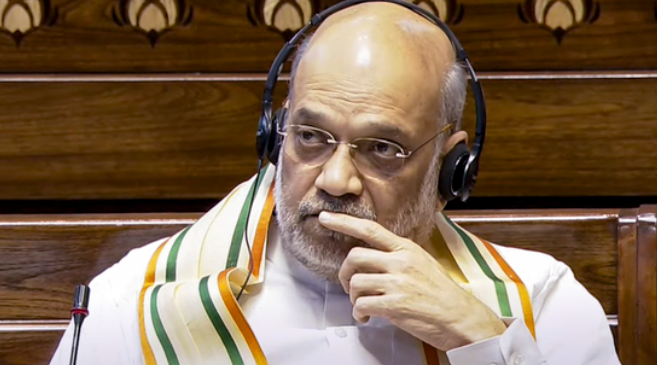
Following the recent terror strike in Jammu and Kashmir’s Pahalgam area, Union Home Minister Amit Shah on Friday had a high-level interaction with all the Chief Ministers of the nation. The overall theme of this high-priority outreach was national security, with Shah instructing all state chiefs to identify Pakistani citizens who are presently living in their respective states.
Shah reiterated the necessity for swift action in the wake of the horrific attack in Pahalgam, where terrorists attacked civilians and security officials alike, giving rise to new concerns on cross-border terrorism and internal security threats. The Union Home Minister was concerned about the possibility of Indian soil being misused by hostile forces, according to sources, and demanded that all state governments work together and make sure that such threats are eliminated at the ground level.
Call for Identification and Reporting
In his interaction with the Chief Ministers, Shah directed them to identify all Pakistani nationals who are in their states and union territories. He asked them to cross-check the information of all Pakistani citizens residing in India — whether on long-term visas, temporary visas, or other travel documents — and report the collected information to the Ministry of Home Affairs (MHA) on priority.
The purpose, Shah explained, is to revoke the visas of these people as a precautionary step and to proceed with their immediate repatriation back to Pakistan, except in case they are in India on particular, legally sound grounds such as marriage to Indians or for official diplomatic purposes.
He emphasized the need for “complete cooperation and vigilance” from the state governments in ensuring internal security and protecting against possible infiltrators or sympathizers of anti-India forces who could be abusing Indian hospitality or legal loopholes.
Security Concerns Intensify
This order comes in the wake of increased tensions in the Kashmir Valley after the Pahalgam attack, which the authorities suspect was carried out by militants with connections to Pakistan-based terror organizations. The attack has once again ignited a national debate regarding the security consequences of having foreign nationals from countries that are known to have anti-India terror groups.
The Centre is not leveling accusations against all Pakistani nationals but taking a zero-tolerance policy in cases where even a handful of people might be a threat to national security, officials say. The initiative has been interpreted as one of the steps aimed at bolstering internal monitoring, advancing visa regulations, and stopping any kind of sleeper cell activity nationwide.
Role of State Governments
The state governments have been asked to cooperate in close association with local police stations, intelligence agencies, and immigration authorities to compile a complete list of Pakistani nationals who are presently staying in their states. These include those who could have come into the country on medical grounds, for studies, religious pilgrimages, family visits, or for doing business.
Shah asked the states to ensure that district-level officers remain alert and conduct detailed background checks on such individuals. He also advised them to look into visa violations, overstays, or any suspicious activities, and immediately flag them to the Centre.
The Home Minister reaffirmed the necessity of availing digital devices, information from hotels and guest houses, educational institutions, hospitals, and telecommunication service providers to verify foreign nationals’ location and activities.
Political and Public Reactions
The decision has drawn divided reactions from the political parties and civil society. While most of the leaders from the ruling Bharatiya Janata Party (BJP) and its allies have supported the move, describing it as a “necessary step in the interest of national security,” some of the opposition leaders have asked the government to take steps to prevent the action resulting in racial profiling or harassment of people who have entered India legally.
Civil rights organizations have also demanded due process be adopted and visa cancellation decisions to be made on the basis of intelligence inputs and proven threats instead of mere suspicion.
However, public opinion across vast sections of the country has shifted towards more stringent measures after a string of attacks in the Kashmir state in recent years. Social media has witnessed a deluge of demands for tighter immigration laws and tighter checks on foreign nationals, particularly from nations with established terror connections.
Broader National Implications
Amit Shah’s aggressive approach marks the Centre’s new focus on national security, border management, and internal intelligence systems. In recent years, India has undergone stark transformations in its attitude towards dealing with foreign nationals, particularly those from Pakistan, Afghanistan, and Bangladesh.
Given that India’s security and intelligence agencies are already in high gear following the Pahalgam incident, this new instruction signals a pivotal paradigm shift towards preventive action from a reactive response.
Experts opine that the step, while helping in curbing potential security threats, will also convey a strong diplomatic message that India is keen on eradicating cross-border terrorism and that it wants foreign tourists to strictly comply with Indian laws and traditions.
The next few days will be important as states start the process of identifying and reporting Pakistani nationals, and the Centre considers its next course of action. Amit Shah’s order is a clear step in the direction of ensuring that India’s internal security framework is strong and capable of responding to new threats. With the Centre and the states working together, the expectation is to strike a delicate balance between national security and individual rights while maintaining the nation’s safety and integrity.