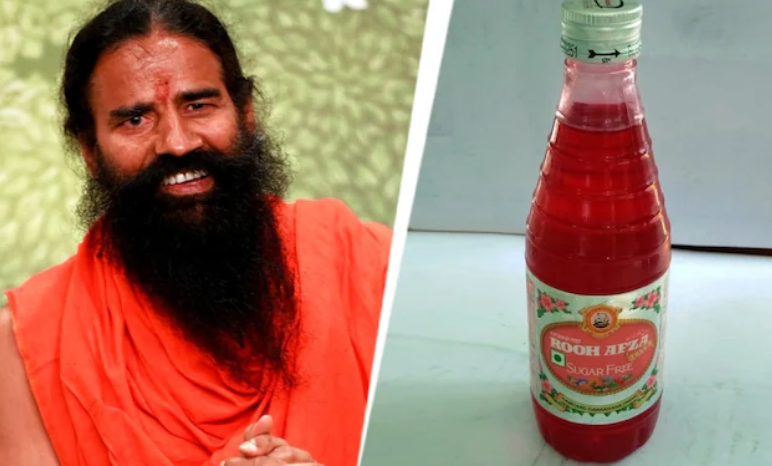
In a landmark legal ruling, Baba Ramdev and his Patanjali organization have committed to removing provocative videos and social media content containing comments on the popular beverage Rooh Afza. This follows after the Delhi High Court denounced Ramdev’s statements, which involved the use of the term “sharbat jihad,” terming them “indefensible” and appalling. The forceful disapproval of the statements issued by the yoga guru has resulted in this quick legal solution.
The Court’s Reaction: A Severe Criticism
The remarks of the Delhi High Court were biting and concise as it responded with indignation to Baba Ramdev’s comments regarding Rooh Afza, a widely sold beverage produced by the Hamdard group. The court judgment centered on the controversial nature of Ramdev’s statements, which were held capable of fanning communal unrest. “I couldn’t believe my ears and eyes when I saw the video,” the judge supposedly remarked.
The court noted Ramdev’s words very seriously, especially his mention of the beverage within a broader social and political discourse. Senior Counsel Mukul Rohatgi, appearing for Hamdard, contended that the video was more than simple disparagement and was actually a kind of hate speech. The lawyer pointed out that such statements were intended to create communal unrest and requested that they be taken down at once.
To counter these arguments, the Delhi High Court found the remarks “shocking” and noted that they shocked the “conscience of the court.” The bench stated that the comments not only slandered a good product but also threatened to increase social polarisation. Consequently, the court explicitly stated that the videos must be removed as quickly as possible.
Ramdev’s Lawyer’s Assurance and Court Orders
In the wake of the reprimand from the High Court, Baba Ramdev’s attorney promised the court that Patanjali would delete the offending videos from its social media channels and all print or electronic ads connected to the comments. “I have been directed and we are withdrawing the videos,” the attorney replied in court, indicating that Patanjali would delete all content containing the offending comments.
The court, in turn, instructed Patanjali’s counsel to file an affidavit detailing that the impugned content would be removed, and that no such statements would be issued in the future. The court requested that the affidavit be filed within five days, with the next hearing set for May 1. The court also made it clear that it did not wish to see any future occurrence of this kind, requesting the parties to ensure that the matter would not arise again.
The Controversial Remarks and Their Impact
The controversy started when Baba Ramdev introduced Patanjali’s own rose sharbat earlier this month. At the launch event, Ramdev made a series of statements that were universally seen as a backhanded reference to Rooh Afza, although he never mentioned the brand by name. Ramdev said that one company’s sharbat (seen as Rooh Afza) was being utilized to finance religious institutions like madrasas and mosques. He also suggested that buying Patanjali’s sharbat would be used to finance institutions with his ideological bent, such as gurukuls and Patanjali University.
Ramdev went as far as to invoke the term “sharbat jihad” in his remarks, comparing it to the much-criticized term “love jihad.” For Ramdev, drinking the beverage in question was tantamount to engaging in a larger social and political agenda that ran counter to his own. He further disparaged competing sharbat brands, comparing them to “toilet cleaners” and describing them as “poison” being marketed as harmless drinks. The comment was intended to promote Patanjali’s own offerings but instead sparked widespread backlash.
Legal Repercussions and History of Controversy
This incident is not the first time that Baba Ramdev and Patanjali have been embroiled in legal challenges. Actually, Patanjali and its founder have been subject to tremendous judicial scrutiny throughout the years, specifically issues with the company’s advertising. In 2023, the Indian Medical Association (IMA) had filed a petition against Patanjali regarding deceptive advertisements making false claims on their products. This led to the Supreme Court issuing interim bans on some of Patanjali ads, together with contempt notices regarding the deceptive claims.
Similarly, in January 2025, a Kerala court issued bailable warrants against Baba Ramdev and Patanjali’s Acharya Balkrishna for failing to appear in a case involving misleading advertisements by Divya Pharmacy. The controversy surrounding Patanjali’s promotional tactics has been ongoing, with several instances of legal challenges and negative publicity surrounding the brand.
Public Backlash and Market Implications
Ramdev’s remarks have spawned a wave of criticism on social media and beyond. Many of the users were outraged by the communal attitude expressed in his remarks, and demanded accountability as well as removal of such content. This criticism also has the potential to dent the public image of Patanjali, a brand that has expanded at a frantic pace in the Indian market. The company, which was widely popular earlier with its Ayurvedic products, is now under growing scrutiny for its marketing strategies.
Hamdard, however, has taken this legal triumph as a chance to detach itself from the controversy and to reinforce its image in the market as a responsible firm with an enduring heritage. The creators of Rooh Afza have existed for ages as one of India’s most esteemed brands, and they would not let such a statement go unchallenged.
Although Patanjali has acquiesced to deleting the posts and videos of the offending remarks, the battle is not over yet. The Delhi High Court has directed the parties to file an affidavit indicating the measures to be taken so that such instances are avoided in the future. This case might establish an important precedent for the way brands and individuals handle sensitive issues in their advertising campaigns, especially when such issues might contribute to communal tensions.
As the case continues to unfold, it is yet to be seen how the public will react to the resolution and whether Patanjali’s actions will revive its image or further damage it. What is certain, however, is that Baba Ramdev’s remarks regarding Rooh Afza have sparked a wider debate regarding the boundaries of free speech in advertising, particularly when it comes to communal harmony and the potential for offense.