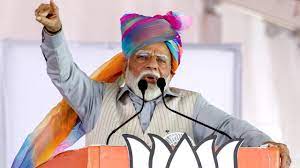
Modi’s Waqf Comment Ignites Firestorm – Here’s What Owaisi, Congress Said
PM Modi’s ‘Puncture’ Remark on Muslims Sparks Massive Political Uproar
One Comment, Many Reactions
A remark by Prime Minister Narendra Modi has stirred up a major political controversy, with several Opposition leaders accusing him of using divisive and disrespectful language to target the Muslim community. While speaking about the misuse of Waqf properties, the Prime Minister suggested that young Muslims are forced to repair punctures due to the dishonesty in how Waqf land is handled. The backlash was immediate—and fierce.
Let’s break down what happened, who said what, and why this issue is now dominating political headlines.
What PM Modi Said: The Waqf Property Controversy
“Muslim Youth Wouldn’t Have to Fix Punctures”
At an event to inaugurate the Hisar airport in Haryana, PM Modi made a pointed comment on Waqf properties—land reserved for charitable or religious use under Islamic law. He said:
“If Waqf properties had been used honestly, Muslim youths wouldn’t need to earn a livelihood by repairing bicycle punctures… A land mafia benefited, not the poor. They looted lands meant for Dalits, backward classes and widows.”
He added that the newly amended Waqf law, recently passed by Parliament, will correct these historical wrongs.
Opposition Hits Back: “Disrespectful and Divisive”
Asaduddin Owaisi: “What Have You Done for the Poor?”
AIMIM leader and Hyderabad MP Asaduddin Owaisi was one of the first to respond. In a sharp attack, he said:
-
If the RSS (BJP’s ideological parent) had used its resources wisely, Modi wouldn’t have had to sell tea in his childhood.
-
He questioned what the Prime Minister had done for poor Hindus and Muslims over the last 11 years in power.
-
Owaisi also warned that the Waqf Amendment Bill weakens the existing Waqf laws instead of strengthening them.
Imran Pratapgarhi: “This Is Troll Language”
Congress MP Imran Pratapgarhi said the PM’s language was no better than social media trolls:
“Muslims don’t just fix punctures. You’ve brought the country’s youth to this situation. There are no jobs.”
He challenged the BJP’s record on Muslim representation:
-
“You talk of Muslim rights but have no Muslim MPs to present the Waqf Bill.”
-
“You threw out leaders like Mukhtar Abbas Naqvi and Shahnawaz Hussain.”
He also pointed out that there are no Muslim women in the BJP’s Lok Sabha, Rajya Sabha, or state assemblies.
Supriya Shrinate: “Where’s Your Dalit CM?”
Congress spokesperson Supriya Shrinate also joined the attack:
-
She asked why PM Modi did not pay tribute to Dr. B.R. Ambedkar on his birth anniversary in Parliament.
-
Responding to the PM’s criticism of Congress not naming a Muslim party chief, she countered:
“Why doesn’t BJP have a Dalit Chief Minister?”
PM Modi’s Defence: “Appeasement Has Hurt Muslims”
“Congress Only Helped Fundamentalists”
PM Modi defended his stance by accusing the Congress of appeasement politics. He said:
“Congress has only made a few fundamentalists happy. The rest of the Muslim community remained poor and uneducated.”
He added that the Waqf law is the biggest proof of how the Congress’s approach failed Muslims.
The Waqf Amendment Bill, passed earlier this month, is now an Act. The BJP claims it will bring transparent and efficient management of Waqf properties.
What Is the Waqf Amendment Bill?
Key Highlights of the New Law
The new law amends how Waqf properties are handled:
-
Introduces stricter rules for documentation and ownership
-
Claims to prevent illegal occupation and land misuse
-
Allows better transparency in the functioning of Waqf boards
The government says this is to protect community assets and ensure poor Muslims benefit from these properties.
Why Is the Opposition Against It?
-
Congress and other parties allege that the government is eyeing Waqf land for its own interests
-
They believe the Bill targets the Muslim community under the guise of reform
-
There are also fears that the Bill centralizes too much power in the government
The Bigger Issue: Politics or Policy?
Targeting Minorities or Fixing a Broken System?
This controversy has raised larger questions:
-
Is the government genuinely trying to clean up corruption in Waqf boards?
-
Or is it using religious minorities for political gain ahead of elections?
-
Are such remarks helping create jobs and uplift the youth, or just deepening divides?
A War of Words, A Nation Watching
One remark by the Prime Minister has now snowballed into a full-blown political showdown. The Waqf Bill may aim to bring reform, but it has come with language that many consider insensitive and offensive.
In a country as diverse as India, words matter—especially from the top. As the election season heats up, this clash over religion, representation, and respect will likely remain in the spotlight.