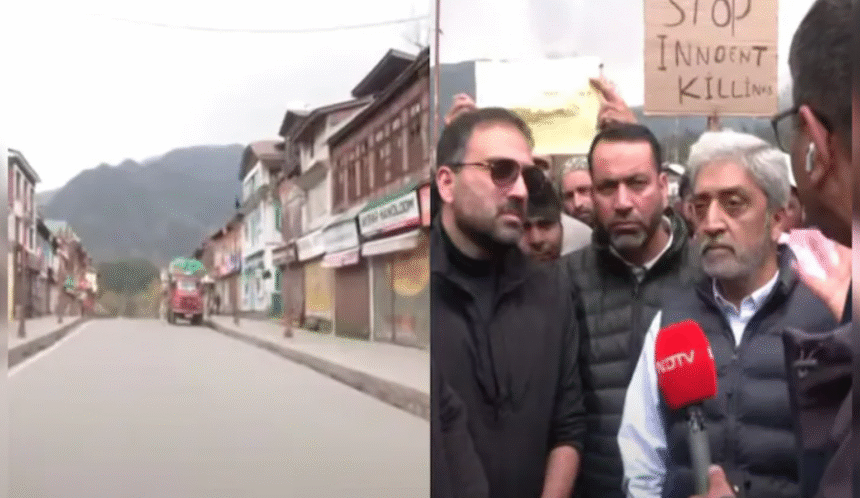
Pahalgam, Kashmir – April 23, 2025: A tidal wave of protests engulfed Kashmir, in the wake of the tragic terror attack that killed 26 innocent tourists in the scenic town of Pahalgam. The attack, carried out on April 22, not only rattled the region but has also left Kashmiris feeling ashamed, grieving, and angry. It was the Valley’s worst terror attack in years, one that has put the entire region into mourning. Kashmir saw a total shutdown for the first time in 35 years, as spontaneous protests broke out across the region in support of the victims and their families.
The case of Pahalgam, a favorite tourist destination, is one of both sorrow and defiance. Local shops were closed, as businessmen, hoteliers, and residents grappled with the barbaric loss of life. Syed Adil Hussain Shah, a local horse ride owner, was one of the 26 victims killed when he gallantly tried to tackle the terrorists as they wreaked havoc. His unfortunate demise has further intensified the collective grief of the community, most of whom had known him as a friend and a representative of the region’s hospitality.
The protests, however, are not merely about grieving the loss of lives. People of Kashmir, especially the business fraternity, have united in a spectacular demonstration of togetherness. Hoteliers and shopkeepers have also organized rallies, shouting slogans like “Hindustan Zindabad” and “I am Indian.” They have assured all assistance to the stuck tourists, promising free stay of up to 15 days so that they stay safe and feel comfortable. Asif Burza, one of the leading hoteliers in Pahalgam, showed his deep sorrow and said, “It is not about tourism, it is not about the economy, our head hangs in shame. What was their fault? They came here to travel, and they were killed. We are only thinking about those families, and we are with them through this pain.”
There is no mistaking the emotion—this attack has hit at the core of Kashmir as much as it has hit at what the people of Kashmir consider most precious. The reaction to the attack has gone beyond economic interests. Kashmiris are one in their indignation and in their call for justice. One of the protesters expressed his determination, stating, “If we are needed, we are completely with the Army. We will not accept this. We are injured at our core. This is not about business or money. This is about humanity.” The people’s rage is evident, and they have indicated that they are completely behind the Indian Army in its bid to retaliate against the perpetrators of the attack.
This deadly incident has made a catastrophic impression on the tourism sector of Kashmir, which had been one of the key areas contributing to the economy of the region. During the last few years, Kashmir had started experiencing a return to tourism after years of prolonged militancy. The arrival of tourists was being looked upon as a good sign of revival and optimism for the region. However, the terror attack has now cast a dark shadow over this progress, and many fear that it will undo the hard-earned peace that Kashmir has been striving for.
The attack has also prompted strong reactions from local leaders. Jammu and Kashmir’s Chief Minister, Omar Abdullah, has condemned the attack in the strongest possible terms, calling it an “abomination.” Expressing his disbelief, Abdullah said, “I’m shocked beyond belief. This assault on our guests is an abomination. The authors of this assault are animals, inhuman, and contemptible. No words of condemnation are sufficient.” He also assured the victims’ families that his government was doing everything it could to help them. After the incident, Abdullah coordinated with authorities to enable the return of stranded tourists safely, including arranging additional flights and de-blocking clogged roads to enable free movement of people.
Prime Minister Narendra Modi, who was in Saudi Arabia during the attack, shortened his trip and flew back to India. In a press statement, Modi assured that those who had carried out the attack would not go unpunished. Home Minister Amit Shah also rushed to Kashmir to assess the situation with Abdullah and Lieutenant Governor Manoj Sinha. The rapid response of the central government indicates the seriousness of the situation and the determination to punish the culprits.
Though the attack has put the region in grief, it has also generated a renewed sense of oneness among the people of Kashmir. The demonstrations, which rage on throughout the region, are a reflection of the determination of the Kashmiri people. Even in the midst of the sea of grief, they have unequivocally indicated that they will not yield to terror. Theirs is a message of defiance, unity, and hope—a hope that the region can be peaceful once again and build its future anew, even amidst the shadows of the past.
Kashmir’s battle is not only against terrorism; it is for its identity, its honor, and its future. While the residents of Pahalgam and elsewhere in the Valley protest, they make a strong statement to the world: Kashmir is not about the pain and the blood that have afflicted it for generations. It is characterized by its people, who, despite tragedy, unite in the defense of their country, their values, and their humanity.
The horrific events of April 22 have left an indelible mark on Kashmir, but they have also shown the resilience and courage of its people. As the protests rage on and the region struggles to cope with the fallout from the attack, the hope is that this dark episode will eventually give way to a brighter, more peaceful future for Kashmir.