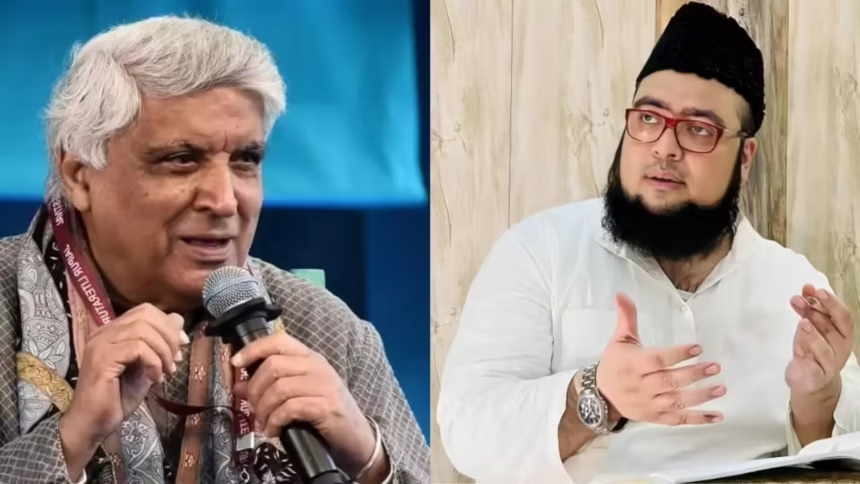
India’s award-winning lyricist and screenwriter Javed Akhtar has strongly condemned reports of a new criminal code introduced by the Taliban in Afghanistan, calling it deeply disturbing and dangerous. His reaction came after news surfaced that the Taliban had formalised rules that allegedly allow a husband to physically assault his wife under certain conditions.
Akhtar took to social media platform X on February 21 to express his anger and concern. His post has since sparked debate, with many supporting his stance and others discussing the broader implications of such laws.
What the New Taliban Law Says
According to international media reports, the Taliban has signed off on a sweeping 90-page criminal code under the leadership of Hibatullah Akhundzada. One of the most controversial aspects of this code relates to domestic violence.
Under the reported provisions:
- A husband may physically assault his wife under certain conditions.
- Legal punishment applies only if the beating results in severe injury, such as broken bones.
- The burden of proof lies with the woman.
- Even if proven, the maximum punishment for the husband is reportedly up to 15 days in jail.
In addition to this, the code allegedly includes restrictions on women leaving their marital homes. If a woman leaves her husband’s house without his permission, she could face up to three months in prison. If she refuses to return upon his request, the punishment may still apply. Relatives who shelter her during this period may also be considered to have committed an offence.
These reported provisions have triggered global outrage, with many calling them a direct attack on women’s rights and safety.
Javed Akhtar did not hold back in his response. In his post on X, he wrote that the Taliban had legalised wife beating, provided it does not cause a bone fracture. He also mentioned the reported rule that a wife could face imprisonment if she visits her parents without her husband’s permission.
In a direct appeal, Akhtar urged religious scholars in India to condemn these developments without hesitation. He stated that since these rules are being justified in the name of religion, it is important for clerics and community leaders to speak out clearly and unconditionally.
His statement has been widely shared, reigniting conversations about religion, law, and women’s rights.
Why This Law Has Sparked Global Concern
Domestic Violence Framed as Conditional
One of the most alarming aspects of the reported code is the framing of domestic violence as conditionally acceptable. Critics argue that allowing physical assault unless it results in “serious injury” effectively normalises abuse.
Experts point out that domestic violence is not defined solely by visible injuries. Emotional trauma, psychological harm, and repeated intimidation are equally damaging. By limiting punishment only to cases involving severe physical injury, the law could make it extremely difficult for women to seek justice.
Burden of Proof on the Victim
Another controversial element is the burden of proof reportedly placed on the woman. In societies where women may already face social and institutional barriers, proving domestic violence can be nearly impossible.
This provision, critics say, further weakens women’s legal protection and could discourage them from reporting abuse altogether.
Restrictions on Women’s Movement
The rule concerning women leaving their husbands’ homes has also drawn sharp criticism. Human rights groups argue that criminalising a woman for seeking refuge or visiting her parents without permission strips her of personal autonomy.
The reported clause that relatives could also face legal consequences for sheltering her adds another layer of fear and isolation. Such provisions, critics argue, could leave women trapped in abusive situations with no safe escape.
The Population Foundation of India Calls It “Dangerous”
The Population Foundation of India described the reports as shocking and dangerous. According to the organisation, any law that effectively legitimises domestic violence amounts to the legalisation of abuse.
The foundation stressed that such measures undermine decades of global efforts to strengthen protections for women and combat gender-based violence.
A Broader Debate Beyond Borders
Javed Akhtar’s statement has not only drawn attention to the situation in Afghanistan but also sparked a broader debate in India and beyond.
His call for Indian religious leaders to condemn the law has raised questions about the role of community voices in global human rights issues. Supporters say that when policies are justified in the name of religion, it becomes especially important for respected scholars to clarify their stance.
Others argue that global solidarity is essential when fundamental rights are at stake.
Women’s Rights Under the Taliban
Since the Taliban regained control of Afghanistan in 2021, there have been widespread concerns about the rollback of women’s rights. Restrictions on education, employment, and public life have already drawn criticism from international organisations.
If the reported provisions of this new criminal code are accurate, they would represent yet another setback for Afghan women, further limiting their freedom and legal protection.
Human rights advocates warn that such laws can create an environment where abuse becomes normalised and victims are silenced.
Why Javed Akhtar’s Voice Matters
Javed Akhtar is not just a lyricist and screenwriter; he is also known for speaking openly about social and political issues. Over the years, he has consistently voiced his opinions on matters related to secularism, equality, and human rights.
His reaction carries weight because of his public standing and long-standing engagement with social issues. By speaking out, he has ensured that the issue remains part of public discourse.
His statement also highlights how cultural figures can influence conversations beyond the entertainment industry.
The Bigger Question
At the heart of the controversy lies a fundamental question: can any legal system justify physical violence within marriage?
Globally, many countries have strengthened domestic violence laws to protect victims and ensure accountability. The reported Taliban code appears to move in the opposite direction, raising concerns about women’s safety and autonomy.
While debates about cultural, religious, and legal interpretations continue, human rights advocates maintain that basic protections against violence should be universal.
Conclusion
The reported Taliban law allowing conditional domestic violence and restricting women’s movement has triggered widespread outrage. Javed Akhtar’s strong reaction has added momentum to the criticism, calling on religious leaders in India to condemn the move without ambiguity.
As discussions continue, the issue underscores the ongoing global struggle for women’s rights and legal protection. Whether through political action, civil society advocacy, or influential public voices, the demand for dignity and safety remains central to the conversation.