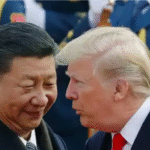
The surge in Asian equities came after both Washington and Beijing issued statements late Thursday indicating substantive progress in their trade discussions. While details remain limited, officials highlighted “constructive” talks focused on tariffs and technology transfer policies, rekindling hopes for a potential resolution that could stave off further escalations in the trade war.
Asia-Pacific indices reflected the positive shift:
Hong Kong’s Hang Seng Index jumped 2.7% in early trading, leading regional gains
Shanghai Composite rose 1.5%, while the Shenzhen Component rallied 1.9%
Japan’s Nikkei 225 advanced 2.3%, its highest close in two weeks
South Korea’s Kospi added 1.4%
Australia’s ASX 200 climbed 1.1%
“Markets are breathing a sigh of relief as dialogue, not confrontation, returns to the fore,” said Alicia Garcia Herrero, Chief Economist for Asia-Pacific at Natixis, in an interview with Reuters. “A meaningful thaw in US-China relations could unleash pent-up investment and improve regional growth prospects.”
Technology, Export Sectors Lead Gains
The prospect of easing trade barriers particularly boosted technology and export-oriented stocks. In Hong Kong, shares of Tencent Holdings and Alibaba Group both soared over 3%, while in Tokyo, chipmaker Tokyo Electron climbed 4.1%. Korean tech giants Samsung Electronics and SK Hynix also outperformed, riding hopes that semiconductor sales could recover if supply chains stabilize.
“Markets are voting with their feet in favor of moderation and compromise,” noted Jingyi Pan, Market Strategist at IG Asia. “We see especially strong buying in export sectors, which have borne the brunt of US-China tensions.”
Currency Markets and Commodities React
The improved mood rippled through currency markets, with the Chinese yuan strengthening 0.4% against the US dollar, its highest level in three months. The Japanese yen edged lower as safe-haven demand eased, while the South Korean won and Australian dollar both notched gains on the day.
On commodities, oil and copper futures both rose, reflecting optimism that global supply chains could normalize and demand may rebound if a trade truce is reached.
Cautious Optimism Amid Uncertain Road Ahead
While investor sentiment has improved, analysts caution that the outcome of US-China talks remains uncertain. Key issues—including technology transfers, intellectual property protections, and the status of existing tariffs—still pose potential sticking points.
“This is a positive step, but underlying frictions are far from resolved,” said Wendy Cutler, vice president at the Asia Society Policy Institute and former US trade negotiator. “It may take substantial patience and flexibility on both sides to reach a lasting agreement.”
Global markets remain on edge ahead of further scheduled talks and the possibility of more concrete announcements. Observers are closely watching for signals regarding tariff rollbacks or shifts in technology investment regulations, both of which could have major repercussions for Asian growth.
Global Repercussions and Policy Responses
A breakthrough in US-China trade relations would have far-reaching implications beyond Asia. Analysts note that Europe and emerging markets stand to benefit from the resulting stability in global supply chains and export demand. Central banks in the Asia Pacific region, who have held policy rates steady amid trade turbulence, may pivot to a more neutral stance if uncertainty abates.
Regional governments, meanwhile, are preparing for both positive and negative contingencies. A spokesperson for China’s Ministry of Commerce commented Friday, “China welcomes dialogue that upholds fairness and mutual respect, and remains committed to safeguarding global multilateral trade.”
Market Outlook and Investor Strategies
Looking ahead, market participants are cautiously optimistic but prepared for volatility. Many fund managers advise a balanced approach, with increased allocations to Asian equities, particularly those in technology and consumer sectors, which may benefit most from sustained improvement in US-China trade dynamics.
“This week’s rally underscores how sensitive global markets are to the ebbs and flows of geopolitical risk,” said Eswar Prasad, Professor at Cornell University and former head of the IMF’s China Division. “The coming weeks will be crucial in determining whether this surge in confidence is sustainable.”