Bollywood’s Age Gap Question: Kajol Pushes, The Khans Dodge
In the very first episode of Two Much With Kajol & Twinkle Khanna, sparks flew—not because of gossip or scandal, but because of a simple, bold question.
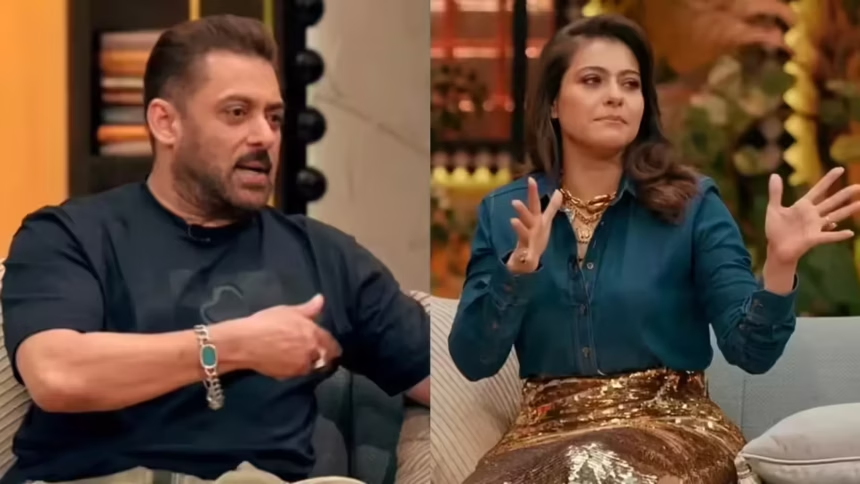
Actress Kajol put Salman Khan and Aamir Khan in the hot seat, asking them why Bollywood continues to favor casting much younger women opposite older male leads, while older women rarely get the same opportunity with younger male co-stars.
Their response? Let’s just say it didn’t exactly hit the mark.
Kajol: “They Didn’t Really Answer It”
Kajol later reflected on the moment in a separate conversation, revealing that neither Salman nor Aamir gave her a straight answer. In her words:
“They beat around the bush a little bit … they kind of did not answer it.”
She recalled their reaction as slightly dismissive, with them insisting, “We don’t think we did that,” or “Did we really do that?” Kajol, clearly amused but also sharp, responded with a raised eyebrow:
“Really? You didn’t think so?”
Her takeaway? It’s a bigger issue than any one actor, and it’s something that even big stars find hard to admit out loud.
What Exactly Was the Question?
Kajol asked a powerful question that echoed what many fans and critics have been thinking for years:
“When a hero romances a younger woman, it’s called ‘cinema magic’. But when an older heroine romances a younger man, it’s called ‘bold’. Why do you think that is?”
The question pointed directly at the double standard in Bollywood’s romantic pairings—a long-standing tradition where men continue to play heartthrobs into their 50s and 60s, while women are often sidelined after their 30s.
Aamir’s Response: The “Story Demands It” Argument
Aamir Khan took the predictable route, saying that casting should be based on the story’s requirement. According to him, if the character’s age and the plot demand it, then the casting makes sense—regardless of age.
He gave examples of when older female actors were cast opposite younger male leads, suggesting the industry has room for both dynamics. However, his examples were rare exceptions, not the norm.
He also defended his own casting choices by suggesting that he and his younger female co-stars “looked the same age” on screen.
While the argument sounded rational on the surface, it didn’t address the real issue: why does the industry keep writing roles where the man is older and the woman is always younger?
Salman’s View: “We Need Freshness”
Salman Khan’s take focused more on the idea of freshness and novelty in casting.
He said that when actors work together repeatedly, the pair begins to look “old” or repetitive on screen. So, for the sake of keeping things fresh and exciting for the audience, new and younger actors are cast.
He suggested that this wasn’t just about age—but about how new or unexplored a pairing feels to the audience. According to him, it’s about chemistry, not chronology.
But Kajol quickly pointed out the flaw: the same rule doesn’t seem to apply in reverse. Why isn’t a younger male actor cast opposite an older female star for freshness? That kind of casting is still rare.
Kajol Keeps It Real
While Salman and Aamir provided their justifications, Kajol made it clear that the issue is bigger than any one film or actor. She acknowledged that this isn’t something she—or even major actors—can easily control. The problem, she hinted, lies deeper in the system.
“You can’t get mad about these things. It’s something out of your control.”
Her calm but clear-eyed response showed both her awareness and her frustration with how little has changed over the years.
Why This Conversation Matters
This wasn’t just a passing moment on a talk show—it’s part of a larger conversation Bollywood still hasn’t fully had. The industry is known for creating love stories between older men and much younger women, and it rarely gets questioned.
Some examples:
- In recent years, actors like Salman Khan, Shah Rukh Khan, Aamir Khan, and Sunny Deol have all starred opposite female leads who are often 20 or more years younger.
- Films like Dabangg, Sikandar, and Sitaare Zameen Par continue the trend, presenting these pairings as completely normal.
- Meanwhile, when a female actor in her 40s is cast with a younger man, it becomes a headline—and often not a flattering one.
What Kajol did was highlight that imbalance and ask why it’s still acceptable. The fact that the two biggest male stars of their generation couldn’t (or wouldn’t) give a straight answer speaks volumes.
The Double Standard: Still Going Strong
There’s a term often used in the industry—”cinematic liberty”—which allows for suspension of disbelief. It’s what lets audiences accept that a 50-something hero is still fighting bad guys, chasing cars, and falling in love with a 20-something woman.
But when the woman is older, the same liberty suddenly vanishes. She’s told she looks “too old,” or she’s cast as someone’s mother or elder sister.
The industry’s silence—or excuses—around this topic often reveal more than their words.
So, What Needs to Change?
- More scripts that center women as romantic leads—regardless of age.
- Filmmakers willing to challenge tradition, not just follow formulas.
- Stars taking a stand, like Kajol did, by simply asking the question and refusing to laugh it off.
- Audiences being open to seeing love stories that don’t follow the usual mold.
Change won’t happen overnight, but conversations like this one are a step forward.
Final Word
Kajol’s courage to ask the uncomfortable question—and to later call out the non-answer—shows why she remains one of Bollywood’s most respected voices. She didn’t attack, mock, or blame. She simply held up a mirror and waited.
Salman and Aamir, for all their stardom, couldn’t quite face what was in it.