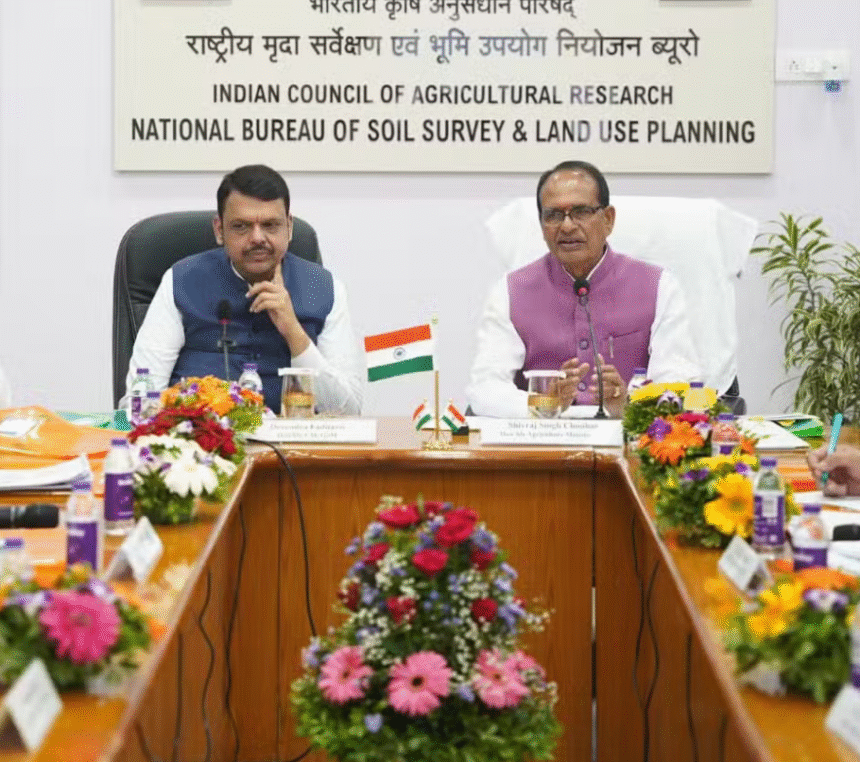
In a major initiative towards improving agricultural and rural development in Maharashtra, the Central Government has reaffirmed its intention to assist the state with multiple schemes and collaborative work. Union Agriculture Minister Shivraj Singh Chouhan participated in a high-level review meeting in Nagpur in order to evaluate the progress of the ongoing initiatives and strategize new plans in accordance with Maharashtra’s diverse agro-climatic regions.
Witnessed by Maharashtra Chief Minister Devendra Fadnavis, State Agriculture Minister Manikrao Kokate, Rural Development Minister Jaykumar Gore, and top bureaucrats, the meeting highlighted the state’s immediate agriculture-related issues, while assuring one-stop support from the Centre.
A Vision for Modern Agriculture
Minister Chouhan stressed calling for a paradigm shift in Indian agriculture through the adoption of modern methods. “We need to incorporate high-quality seeds, organic manures, and modern agriculture technology to improve productivity and sustainability,” he stated. He wants to have a robust farming system that can realize itself to altered climate trends and market needs.
The emphasis was particularly intense on innovation in crop variety. Chouhan appealed to agricultural scientists and research institutions to create high-yielding varieties, especially of cotton, which could flourish in low-rainfall and climate-susceptible areas such as Vidarbha and Marathwada. He mooted a region-based ‘Best Cropping Model’ for Maharashtra that would give farmers scientifically recommended guidelines according to local conditions.
Streamlining Support with Farmer ID
A major policy instruction that was issued at the meeting was the establishment of a distinctive Farmer ID system. Chouhan asserted that the benefits of upcoming schemes should go to registered farmers alone so that they are transparent and accountable while distributing government resources. The identification system seeks to digitize and consolidate farmer databases so that subsidies, training programs, and crop insurance can be targeted more effectively.
This online intervention, if done in the right manner, is likely to minimize leakages in the system and empower true farmers by giving them easy access to several benefits and schemes.
State and Centre: A Unified Front
Chief Minister Fadnavis welcomed the Centre’s initiative and assured that the state government would remain in touch with central agencies and keep contributing to changing the face of agriculture. “We have always been strong advocates of cooperative federalism, and today’s meeting is a testimony to our commitment to farmers,” said Fadnavis.
Principal Secretary of Agriculture Vikas Rastogi gave a comprehensive briefing on the agro-economic conditions in the state, including irregular rainfall, decreasing fertility of the soil, and pest problems. He also detailed preparedness actions for the next Kharif season. These would form the foundations to re-tune current policies and programs.
Acknowledging Grassroots Innovation
One of the highlights of the review meeting was the acknowledgment of farmers who have been at the forefront in bringing about innovative changes. Chouhan credited the endeavors of Raosaheb Mohite, Eknath Talekar, and Vandana Rathod—those farmers who have been able to nurture sericulture and orchid farming under difficult circumstances. Their efforts, he added, must be made public to motivate others.
“Such success stories are not exceptions but a peep into what can be achieved when knowledge, work, and innovation converge,” Chouhan said. He asked state government officials to collect and disseminate such case studies as instructional material for agricultural communities.
Rural Development Expanding
Apart from agriculture, the session also assessed the performance of centrally funded schemes of the Rural Development Department. Principal Secretary Eknath Dawale gave a report on the implementation of flagship programmes including the Prime Minister Awas Yojana (Rural), PM Janman Yojana, and the Prime Minister Gram Sadak Yojana.
Chouhan was pleased with the achievements, particularly under MGNREGA (Mahatma Gandhi National Rural Employment Guarantee Act), where Maharashtra has achieved or surpassed its work goal for the year. He urged the state to keep using the programme to develop long-lasting assets while offering rural employment.
Empowering Women Through the Majhi Ladki Bahin Yojana
Discussions on Maharashtra’s ambitious Majhi Ladki Bahin Yojana, a plan to economically empower women in the state, were also a part of the meeting. Fadnavis informed that the scheme has already empowered thousands of women to begin microenterprises and meet basic expenses.
With a ambitious goal of making one crore economically independent women—”Lakhpati Didis” as they’ve come to be called—the scheme aims to revolutionize rural economy through inclusive development. Chouhan appreciated the scheme, observing that it was in line with the Centre’s larger agenda of women-driven development.
Moving Ahead
The review meeting ended with a new sense of mission and collaboration between the central and state governments. The unambiguous guidance by Minister Chouhan and the warm welcome from state officials reflect a common commitment to modernize Maharashtra’s agriculture, improve rural infrastructure, and enhance the living standards of millions of farmers.
As Maharashtra prepares for the Kharif season, the combined strategies hammered out in Nagpur are likely to take center stage in ensuring that assistance reaches every nook and corner of the state—where it is most required.