Tensions Explode at LoC: India Retaliates After 9 Nights of Pakistani Firing
9th Night of Ceasefire Violation by Pakistan: India Responds With Force and Full Freedom
Tensions are dangerously high along the Line of Control (LoC) as the Pakistan Army continues its unprovoked firing on Indian positions for the ninth consecutive night. India, no longer holding back, has responded “promptly and proportionately,” with full operational freedom granted to the Armed Forces.
Continuous Firing From Pakistan Along LoC
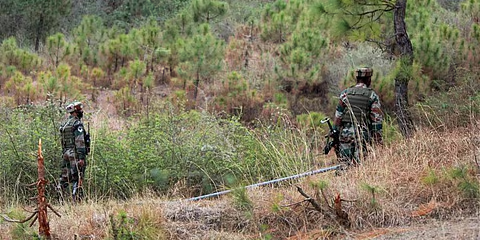
On the night of May 2 and 3, the Pakistan Army opened small arms fire targeting Indian Army posts across the Kupwara, Uri, and Akhnoor sectors in Jammu and Kashmir.
The Indian Ministry of Defence confirmed that the firing was unprovoked and occurred across several stretches of the de facto India-Pakistan border known as the Line of Control (LoC).
Areas Affected by Pakistani Firing:
-
Kupwara Sector (North Kashmir)
-
Uri Sector (Baramulla district)
-
Akhnoor Sector (Jammu region)
This marks the ninth consecutive night that Pakistan has violated the 2021 ceasefire agreement, which both countries had earlier agreed to honor after years of deadly cross-border skirmishes.
India’s Response: “Prompt and Proportionate”
According to the Defence Ministry, the Indian Army responded strongly to the provocation. The retaliation was both swift and measured, maintaining control while defending Indian positions.
“The Indian Army responded promptly and proportionately,” the ministry said in a statement.
Indian forces have also increased surveillance and readiness along the LoC, deploying counter-measures and boosting troop presence in volatile areas.
Diplomatic War Heats Up After Pahalgam Terror Attack
This round of ceasefire violations began soon after the April 22 Pahalgam terror attack, in which 26 Indian civilians were killed.
Pakistan’s Permanent Representative to the UN, Asim Iftikhar Ahmad, made a provocative statement, warning of an “imminent threat of kinetic action” from India. He also denied any Pakistani involvement in the Pahalgam incident and condemned India’s response as escalatory.
India, however, has made it clear that there will be no tolerance for terrorism or cross-border aggression.
April 22 Massacre in Pahalgam: The Spark Behind Rising Tensions
The massive terror attack on April 22 in Pahalgam, Jammu and Kashmir, shocked the nation. Terrorists opened fire on civilians, killing 26 people, including women and children.
Investigations revealed that Adil Hussain Thokar and Asif Sheikh—both linked to Pakistan-based terror groups—were behind the attack.
In response, India:
-
Demolished the homes of both Thokar and Sheikh
-
Increased counter-terror operations in the Valley
-
Declared that any link to terror will face harsh consequences
India’s Stringent Measures After the Attack
The Indian government responded to both the terror attack and ceasefire violations with a series of strong punitive actions against Pakistan:
Major Actions Taken by India:
-
Closed the Attari-Wagah border crossing – halting people-to-people exchanges
-
Deported all Pakistani nationals residing in India on temporary permits
-
Suspended the Indus Waters Treaty (signed in 1960) – a major symbolic move
-
Closed Indian airspace to Pakistani commercial flights
These decisions signal India’s intent to diplomatically isolate Pakistan, along with military preparedness on the ground.
Pakistan’s Response: Simla Agreement Disregarded
In a drastic countermeasure, Pakistan announced that it would no longer adhere to the 1972 Simla Agreement, the very document that formalized the LoC as the boundary in Jammu and Kashmir.
This declaration effectively means Pakistan no longer recognizes the LoC, increasing fears of more ceasefire violations and escalated conflict in the region.
PM Modi Grants Armed Forces Full Operational Freedom
Following the Pahalgam attack, Prime Minister Narendra Modi reportedly gave the Armed Forces complete operational freedom to respond as necessary.
This includes:
-
Pre-emptive strikes
-
Targeted counter-terror operations
-
Cross-border retaliation if provoked
The Army, Air Force, and Navy have all been placed on high alert, and intelligence-sharing has been intensified among agencies.
What This Means for India-Pakistan Relations
This is one of the most serious breakdowns of the ceasefire since the 2021 agreement. Analysts are concerned that this may be the beginning of a larger escalation, especially given:
-
Ongoing UN diplomatic debates
-
Terror group activity in Kashmir
-
Pakistan’s denial of involvement in cross-border attacks
Security Experts Speak:
Lt. Gen. S.K. Chatterjee (Retd):
“Pakistan’s firing isn’t just provocation—it’s a signal. The Indian Army must remain aggressive and alert.”
Dr. Arvind Rajan, Strategic Analyst:
“India’s airspace closure and suspension of the Indus Treaty are significant. It’s more than symbolic—it’s a geopolitical warning.”
What’s Likely to Happen Next?
As tensions climb, the following developments are expected in the coming days:
-
More LoC skirmishes if diplomatic talks fail
-
Retaliatory strikes by Indian forces in terror hotbeds
-
Increased deployment of troops and surveillance systems
-
International pressure on Pakistan to curb terror links
Ceasefire Hangs by a Thread
The ninth consecutive night of ceasefire violation by Pakistan is not just a military issue—it’s a diplomatic and humanitarian crisis in the making. With civilians dying, terror networks active, and borders heating up, the region faces a fragile and dangerous moment.
India’s assertive military and diplomatic responses suggest that any further aggression will be met with force, not patience.