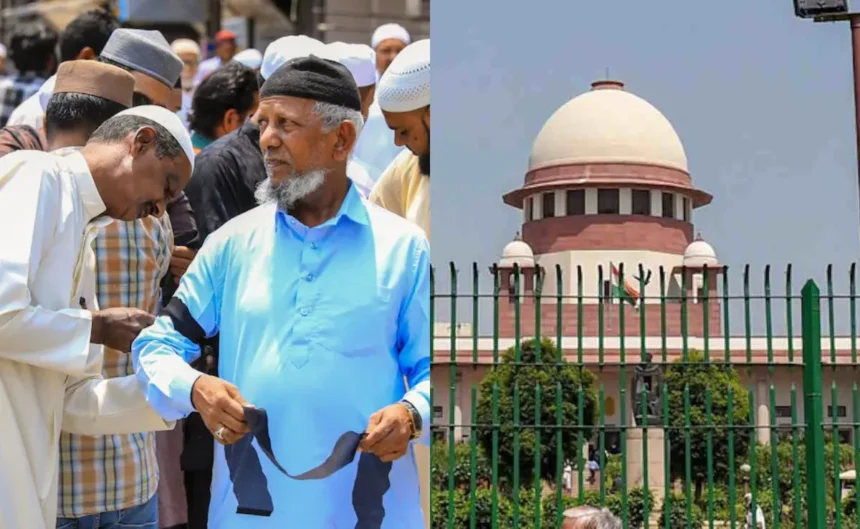
In a dramatic and heated hearing on the controversial Waqf Amendment Act, the Supreme Court on Thursday posed sharp questions to the Central government regarding the provisions of the new law—particularly with respect to ‘Waqf by user’ and the presence of non-Muslims in the Central Waqf Council. Chief Justice of India Sanjiv Khanna left the government shocked with a sensational comment, “Will you permit Muslims to serve on Hindu endowment boards? Say it clearly.
The bench, comprising Justice Sanjay Kumar and Justice KV Viswanathan, was considering a batch of 73 petitions filed against several provisions of the Waqf Act. The hearing saw stinging observations and constitutional scrutiny as veteran lawyers such as Kapil Sibal and Abhishek Manu Singhvi presented that the law constitutes violation of fundamental rights under the Constitution.
Key Issues: Waqf by User and Religious Autonomy
One of the more controversial provisions of the new law is how it approaches ‘Waqf by user’—an idea that a property, even if not documented, is Waqf because it has been in use for religious or charitable purposes for centuries. This stipulation, the petitioners say, is being eroded by the amendment, which now excludes disputed or government land from being designated Waqf.
Kapil Sibal, representing one of the petitioners, argued that the Act violates Article 26 of the Constitution, which protects the right to administer religious affairs independently. “The Collector, who is a government servant, is being vested with judicial powers under this law. That is unconstitutional,” he said. He further stated that in Islamic practice, a waqf may be centuries old, and to insist on formal deeds for such properties is impractical and unjust.
Senior Counsel Abhishek Singhvi reinforced the case, observing that almost half of India’s 8 lakh Waqf assets fall under the ‘Waqf by user’ category. At this point, the Chief Justice said, “We are informed the Delhi High Court sits on Waqf land. We are not saying all Waqf by user is improper, but there is real concern.”
The bench was worried that the new law could render historic waqfs invalid. “Many mosques were built in the 13th, 14th, 15th centuries. How can they produce documentation? You cannot undo all that history now,” Chief Justice Khanna remarked. He cautioned that the government’s move to “denotify” such waqfs would take away legal sanction given by earlier court verdicts and customary usage accepted even by the Privy Council in the British period.
Central Waqf Council Composition Raises Eyebrows
The composition of the Central Waqf Council under the reformed Act, where non-Muslims can now be appointed, was another point of contention in the hearing. This raised constitutional and communal concerns in court.
Chief Justice Khanna asked Solicitor General Tushar Mehta, on behalf of the Centre, a blunt and pointed question:
The message of the question was unmistakable: if the government is going to insist on letting non-Muslims join Waqf institutions, why are Muslims being denied entry into boards that govern Hindu religious trusts? The question drew attention to the larger question of religious autonomy and whether the state is being even-handed in its application of standards across religions.
Violent Demonstrations and the Role of Law
The hearing also noted the violence and protests breaking out in various parts of the nation regarding the new Waqf law. “It is very disturbing,” Chief Justice Khanna said, looking back at the unrest. When Solicitor General Mehta indicated that the protests could be meant to pressure the system, Kapil Sibal responded, “We don’t know who is pressuring whom.”
In spite of the hot argumentations, Chief Justice admitted there could be a few “good points” of the new legislation, but said they should be debated openly and justly. He stressed the government cannot revoke court rulings with the help of parliament and asked for clarity of how the new provisions will work without infringing on religious freedom.
What’s Next?
The Supreme Court has not yet decided whether it will send the case to a higher court or retain it for itself, but it has requested that the petitioners specify the exact constitutional issues they intend to bring up. In the meantime, the court has resolved to proceed with the case and has set the next hearing for tomorrow.
With profound constitutional, communal, and historical significance, this case is likely to be a landmark one in deciding the destiny of religious property management in India. The balance between state regulation and religious freedom hangs in the balance, as does the larger question of how inclusive or exclusionary India’s religious government institutions should be.