Shells Over Silence: Pakistan Defies Ceasefire for 8 Nights After Deadly Pahalgam Attack
Pakistan Violates Ceasefire for 8th Night in a Row Amid Soaring India-Pakistan Tensions
Unprovoked Firing Along LoC Follows India’s Strong Measures After Pahalgam Attack
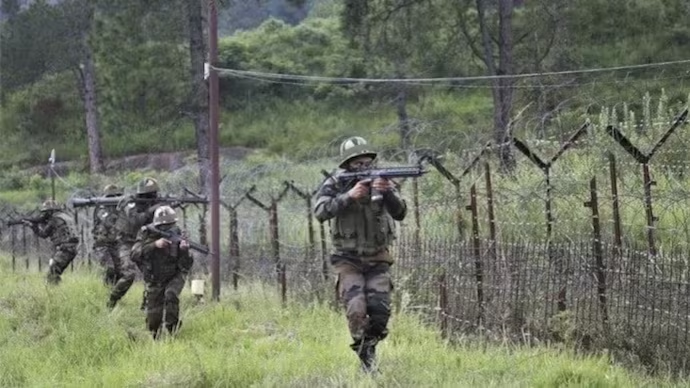
For the eighth consecutive night, the Pakistan Army has violated the ceasefire agreement by launching unprovoked firing across the Line of Control (LoC). The firing has been reported in several key areas of Jammu and Kashmir, intensifying fears of escalation between the two nuclear-armed neighbours.
This renewed aggression comes in the wake of a deadly terror attack in Pahalgam on April 22, which killed 26 civilians. In response, India has taken major retaliatory steps—including suspending the Indus Waters Treaty and closing down the Attari border crossing.
Where Did the Firing Occur?
Key Areas Affected by Cross-Border Firing:
-
Kupwara
-
Baramulla
-
Poonch
-
Naushera
-
Akhnoor
These regions along the 740-km-long LoC have seen continuous small arms fire from Pakistani posts, prompting swift and measured retaliation by Indian forces.
The Bigger Picture: Pahalgam Attack Fallout
Timeline of Escalation:
-
April 22: A terror attack in Pahalgam leaves 26 Indian civilians dead.
-
April 24 Night: Hours after India suspends the Indus Waters Treaty, Pakistan starts firing along LoC.
-
April 30 – May 1: Cross-border firing expands to Pargwal sector along the International Border in Jammu district.
This marks a significant widening of the conflict zones—from the LoC to the IB, raising concerns of a larger military flare-up.
Military Hotline Activated
The Directors General of Military Operations (DGMOs) from both countries engaged in a rare phone call this week. According to sources familiar with the conversation, India issued a stern warning to Pakistan over these repeated violations.
While official statements have been minimal, the conversation is seen as a last-ditch effort to de-escalate before potential artillery exchanges or further diplomatic fallout.
Civilians Brace for Escalation
Preparations Along the Border:
-
Residents living near the LoC and International Border are clearing and preparing bunkers for shelter.
-
Harvesting operations are completed in R.S. Pura and Arnia sectors but are still ongoing in Kathua, Samba, Rajouri, and Poonch districts.
Farmers and civilians are caught between their livelihoods and looming danger, with local authorities urging readiness for potential shelling.
India’s Tough Response to Pahalgam Attack
Following the Pahalgam massacre, India unveiled a series of sharp countermeasures targeting Pakistan:
Punitive Measures Taken by India:
-
Suspension of the Indus Waters Treaty
-
Closure of the Attari land border crossing
-
Downgrading diplomatic ties with Islamabad
India’s messaging is clear: Pakistan will be held accountable for cross-border terror support and any further provocations.
Pakistan Retaliates Diplomatically and Economically
Pakistan’s Countermoves:
-
Airspace closed to Indian airlines
-
All trade with India suspended, including third-country routes
-
Outright rejection of India’s suspension of the Indus Treaty
Pakistan has also called India’s water-related actions an “act of war,” raising fears that the confrontation could spiral into a more dangerous face-off.
The India-Pakistan Border: Know the Terrain
India and Pakistan share a complex and militarized border:
Border Breakdown:
-
International Border (IB): ~2,400 km (from Gujarat to Akhnoor in Jammu)
-
Line of Control (LoC): 740 km (cuts through Jammu and Kashmir)
-
Actual Ground Position Line (AGPL): 110 km (divides Siachen region)
Understanding this geography helps frame how localized skirmishes can quickly spread across multiple sectors.
Ceasefire History: A Fragile Peace
In February 2021, the DGMOs of India and Pakistan had agreed to strictly uphold the 2003 ceasefire agreement. That accord had led to a significant drop in cross-border firing incidents.
However, the repeated violations in 2024 and now into 2025 signal that the fragile peace may be breaking once again.
What Happens Next?
The ongoing ceasefire violations, combined with diplomatic breakdowns and domestic political pressure on both sides, suggest more escalation could be on the horizon.
India is unlikely to let the LoC remain active without pushing back decisively—militarily, diplomatically, or both.
Meanwhile, civilians in border villages remain on edge, living between bunker drills and prayers for peace.
The situation along the LoC is once again volatile, and the eight nights of continuous firing could mark the beginning of a prolonged standoff. With water treaties suspended, borders closed, and shots fired, the next steps from both nations will be critical in determining whether this ends in dialogue—or something much more dangerous.