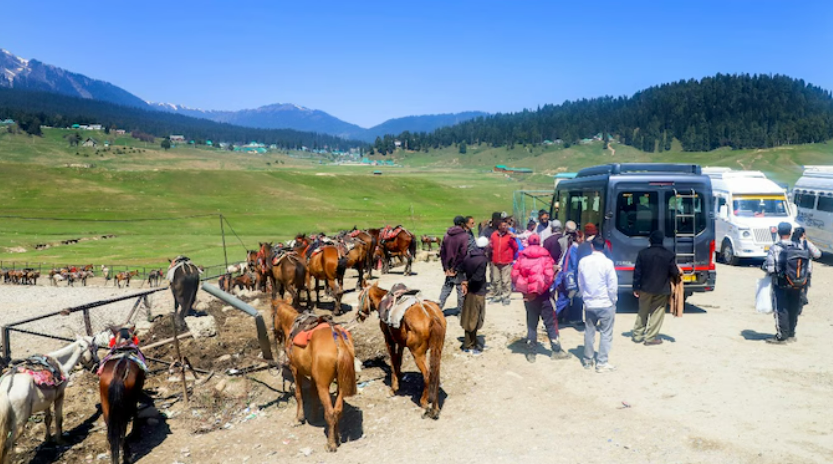
In a dramatic crackdown on rising threats, the Jammu and Kashmir government has shut down 48 of 87 tourist spots in the Kashmir Valley following reports that indicate highly likely terror attacks. The drastic action comes in the aftermath of last week’s fatal militant attack on tourists in Pahalgam and follows a disturbing trend of growing militant activity in the valley.
Intelligence agencies, according to sources, have intercepted messages that reveal several sleeper cells have been activated in the Valley. These sleeper cells, thought to be sponsored by Pakistan-based terror groups, have been instructed to launch fresh attacks, as per reports. The attacks have been described as retaliatory as well as premeditated—against security personnel and non-locals, including tourists.
The intelligence report read by India Today clearly informs that, “In the wake of the recent militant attack on tourists dated 22.04.2025, sound inputs from trusted sources and sister intelligence agencies indicate militant organisations are planning acts of violence targeting security personnel and non-local people in the coming days.”
The Trigger: Pahalgam Attack and Retaliatory Crackdown
On April 22, 2025, militants staged a vicious attack in the Pahalgam area, one of Kashmir’s most sought-after tourist destinations. The attack resulted in several civilian fatalities and caused shockwaves among the local population and the national security establishment. In the aftermath of the attack, security forces conducted retaliatory operations that involved the demolition of hideouts and safehouses belonging to the terrorists involved.
But these operations, successful in the short term, seem to have ignited new designs for revenge. Intelligence sources now estimate that the eradication of these safe houses—most of which were also double as family residences—has radicalized further underground networks and reignited sleeper cells in hibernation for months.
Targeted Killings and Bigger Plots Feared
Security officials indicate that the intercepted militant chatter indicates a two-pronged plot. In the first instance, there could be the targeted killing of non-local workers and tourists, designed to create a climate of fear and disquiet. On the second front, a bigger coordinated attack is under planning—perhaps on a prominent target or during a large gathering, such as an event or festival.
A senior officer in the know, while speaking anonymously: “The perception of the threat is maximum in the last few months. Closing the tourist places is a precautionary step, not a retaliatory one. We do not want a repetition of something like Pulwama or Uri.”
Tourism Hit Hard
The choice to close down more than half of Kashmir’s listed tourist destinations has cast a deep shadow on the Valley’s sensitive tourism sector, which has just started to revive after years of COVID-related and political setbacks. April to June is tourist season in Kashmir, with people coming to see the scenic beauty, tulip gardens, and preparations for the Amarnath Yatra.
Hoteliers and tour operators already are reporting bulk cancellations. “Just when we thought things were worst over, this had to happen,” complained Shahid Mir, the owner of a hotel in Gulmarg. “Safety first, but economic losses are going to be immense.”
Based on government estimates, tourism contributes close to 8% to Jammu and Kashmir’s economy, directly and indirectly employing hundreds of thousands of people. Now, with the freeze on travel to almost 55% of the Valley’s prime spots, those jobs are in jeopardy.
Strategic Reassessment
The shutdown of tourist sites also marks a change in the security stance of the government. Historically, the government has shunned blanket shutdowns in favor of surveillance of specific areas and intelligence-driven operations. But the character of the threat this time seems diffuse and entrenched, compelling a wider crackdown.
Security has been reinforced at major points of entry, such as Srinagar airport, and more forces have been posted to exposed districts. Hotels, religious shrines, and transportation centers are kept under constant watch.
“Previously, we were able to reduce the threat to a region or a group,” said a high-ranking intelligence official. “Now the communication hints at several groups, perhaps coordinated, and striking soft targets such as tourists or yatris.”
Political and Social Consequences
The action has not been without opposition. Local leaders have complained that these restrictions, while justified, should not become permanent. “We need to save lives, yes, but we also need to prevent fear from becoming the new normal,” a former MLA from South Kashmir was quoted saying.
Human rights activists have also voiced concern at the heavy-handed treatment in some of the counter-terror raids. They claim that blanket demolishing of homes thought to be connected with militants has the potential to backfire and alienate additional youth.
Still, the government has insisted that everything done is legal and justified by the current threat levels. A government official repeated: “Our first concern is the security of all people in Jammu and Kashmir—locals or visitors. All measures taken are with that objective in mind.”
As the region prepares for a potentially explosive summer, the focus is now on the intelligence community and the military to ensure that there is no escalation. Negotiations are also underway between state authorities and tourism stakeholders to come up with contingency plans.
The coming weeks will be decisive. With the threats still ongoing, the administration has indicated that it will carry out a periodic review of the security situation before reopening any closed destinations.
Until now, Kashmir continues to stay on high alert, and the Valley’s fantasy of a quiet, tourist-abundant summer balances precariously.