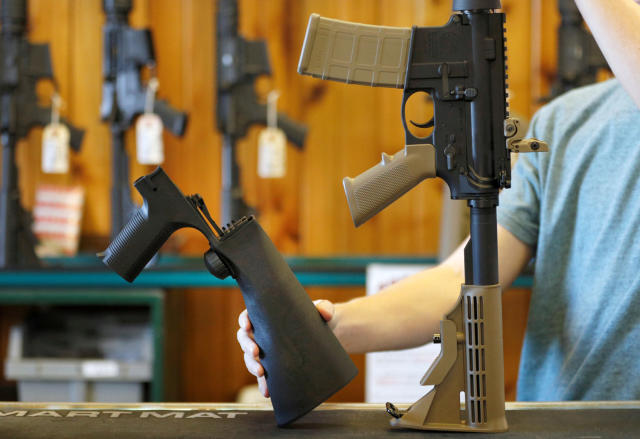
The U.S. Supreme Court on Friday struck down a rule enacted following the 2017 mass shooting in Las Vegas that defined a semiautomatic rifle equipped with a bump stock attachment as a machine gun, which is generally prohibited under federal law. The opinion, written by Justice Clarence Thomas, reduces the executive branch’s already-limited ability to address gun violence. Thomas, a strong defender of Second Amendment gun rights, wrote that the Bureau of Alcohol, Tobacco, Firearms and Explosives (ATF) exceeded its statutory authority in prohibiting the sale and possession of bump stocks, which he said differed importantly from machine guns.
“Nothing changes when a semiautomatic rifle is equipped with a bump stock,” Thomas wrote. “Between every shot, the shooter must release pressure from the trigger and allow it to reset before reengaging the trigger for another shot.”

The court’s established ideological lines were broken in the Garland v. Cargill case, which resulted in a 6-3 ruling. The senior member of the liberal court’s opposition, Justice Sonia Sotomayor, claimed that the ruling returns “bump stocks to civilian hands” in her opinion. “I call that bird a duck,” she said, referring to birds that walk, swim, and quack like ducks. A semiautomatic rifle fitted with a bump stock can fire multiple shots automatically, without the need for manual reloading, with only one pull of the trigger. I respectfully disagree because, like Congress, I consider that to be a machine gun..”
The White House slammed the decision. “Today’s decision strikes down an important gun safety regulation,” President Joe Biden said in a statement. “Americans should not have to live in fear of this mass devastation.” Biden called on Congress to ban bump stocks and assault weapons, but any gun-related legislation is likely to be stalled with Republicans controlling the House and Democrats holding only a slim majority in the Senate. Senate Majority Leader Chuck Schumer echoed these sentiments, stating, “Bump stocks have played a devastating role in many of the horrific mass shootings in our country, but sadly it’s no surprise to see the Supreme Court roll back this necessary public safety rule as they push their out-of-touch extreme agenda.”
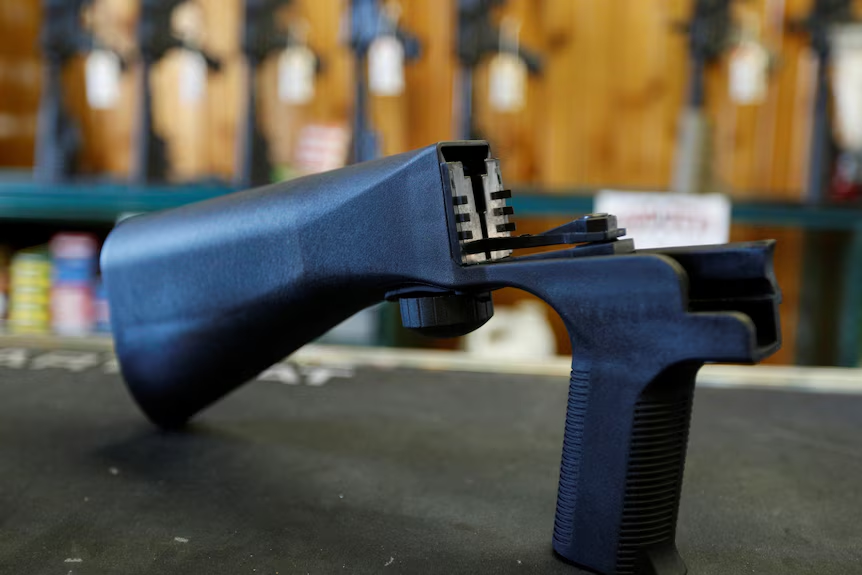
This case stems from a regulation set during the Trump administration, following the mass shooting in Las Vegas. A gunman used rifles outfitted with bump stocks to fire into a crowd at a music festival, killing 58 people that night and two more who died of their injuries later, and injuring more than 500. The next year, the ATF issued the rule that concluded bump stocks are illegal machine guns. Anyone who owned or possessed a bump stock was required to either destroy the material or turn it in to the agency to avoid criminal penalties.
Michael Cargill, a gun shop owner in Austin, Texas, surrendered two bump stocks to ATF and then challenged the rule in federal court. A U.S. district court dismissed his case, but the U.S. Court of Appeals for the 5th Circuit agreed with Cargill that a 1986 law’s definition of a machine gun does not apply to bump stocks because the rifles equipped with the attachments don’t shoot multiple bullets “automatically,” or “by a single function of the trigger.” That law defined a machine gun as “any weapon which shoots, is designed to shoot, or can be readily restored to shoot, automatically more than one shot, without manual reloading, by a single function of the trigger.” The Biden administration appealed the 5th Circuit’s decision to the Supreme Court.
In oral arguments, the Biden administration defended the Trump-era rule and said that bump stocks allow semiautomatic rifles to fire automatically with a single pull of the trigger. Attorneys for Cargill argued that bump stocks are used by repeatedly pulling the trigger, rather than firing automatically with a single pull. In her dissent, Sotomayor said the decision will limit the federal government’s “efforts to keep machine guns from gunmen like the Las Vegas shooter.”
Thomas also wrote a major gun decision in 2022 that invalidated a New York law against carrying a firearm in public without showing a special need for protection. The court decided the case on 14th Amendment grounds, but it also expanded Second Amendment rights. Because of that 2022 decision, another gun-related case is before the court this session that tests a federal law that prevents the possession of firearms by a person who is subject to a domestic violence protective order. A decision is expected this month.

The implications of the Supreme Court’s decision are significant. By striking down the bump stock regulation, the court has limited the ability of federal agencies to interpret and enforce gun control measures without explicit legislative action. This decision may set a precedent for future challenges to gun regulations and could influence the balance of power between the executive and legislative branches in shaping gun policy. Furthermore, it underscores the ongoing ideological divide within the court regarding Second Amendment rights and the extent of regulatory authority. As the debate over gun control continues, this ruling will likely play a pivotal role in shaping the legal landscape surrounding firearms in the United States.