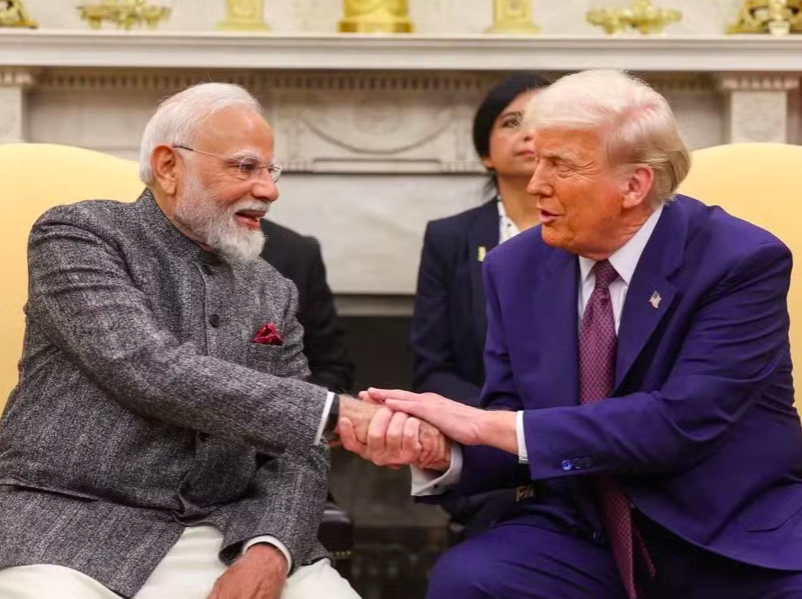
In a dramatic step that could redraw the course of U.S.-India economic relations, U.S. President Donald Trump declared that the United States is on the brink of completing a significant trade agreement with India. This follows as part of a larger plan by the Trump administration, which involves the laying of new tariffs between 25% to 40% on a diverse group of countries. Significantly, India has been left out of this tariff wave, suggesting its good standing in the ongoing talks.
A Strategic Exemption Amid Rising Trade Tensions
During a press conference on Monday, President Trump stated that while the United States will be levying steep tariffs on more than a dozen nations — including Japan, South Korea, Malaysia, and Laos — India will not see the same. The new tariffs will go into effect on August 1 and are one of the most forceful trade enforcement actions of Trump’s current presidency.
“We are nearing an agreement with India. They have shown good faith in negotiations,” Trump stated, while reinforcing that the U.S. would not hesitate to act against countries that have been “unfair” in trade dealings. “We’ve already concluded successful agreements with the UK and China. India could be next.”
This waiver is being seen as a strategic gesture, indicating the White House’s intent to encourage nations that are willing to negotiate a trade agreement, and an offer to India to seal the deal before the deadline in August.
What the Tariffs Mean for the Global Economy
The U.S. tariffs are intended to address trade imbalances Trump believes have disadvantaged American industries. Trade surplus countries — particularly Japan and South Korea — have been under the spotlight, with Trump deeming these surpluses a “major threat to U.S. national security.”
Letters of tariff terms have been said to have been sent to countries that are not cooperating by showing unwillingness to negotiate. The letters set U.S. demands and provide these countries with a limited time frame to get to the negotiating table. This is in a similar hardline tactic of Trump during his first term, although the interest seems more elevated now as he makes a second bid to redefine America’s place on the global trade map.
India’s Balancing Act
India, meanwhile, has been negotiating with the U.S. for several months. The points of disagreement are now well-known: agricultural imports, tariffs on dairy products, and access to digital services. But Indian officials have indicated that they are willing to make concessions to American interests in some areas.
New Delhi has pledged to boost American arms and liquefied natural gas (LNG) purchases as part of a broader effort to cut its $45 billion trade surplus with the U.S. Indian Ministry of Commerce sources suggest that an agreement could involve intellectual property guarantees, digital trade rules, and even limited access to American farm products.
Ajay Sahai, Director General of the Federation of Indian Export Organisations, pointed out that the time constraint of the deal cannot be overemphasised. “Indian exporters are keenly observing these developments. The new tariffs on other Asian economies may favor India or injure it depending on how quickly we can seal our agreement. We don’t wish to remain in limbo.”
A Narrow Window Before August 1
Despite optimism, there are challenges. With a deadline of August 1 looming, negotiators from both sides are under extreme pressure to seal the deal. The office of the U.S. Trade Representative is said to have wrapped up its technical-level talks with Indian counterparts, and the terms now wait for political clearance.
Commentators say that Trump’s move from sweeping multilateral trade agreements to bilateral agreements — and the rhetoric of “America First” that comes with it — has complicated negotiations. His administration’s initial target of “90 deals in 90 days” has obviously proved unrealistic, with few substantive agreements to show. Still, achieving a trade deal with India — the world’s fastest-growing major economy — would be a key coup for the Trump administration.
“India is an important strategic partner,” a senior White House official was cited as saying. “We desire a deal that will help both countries. But the president is equally firm: If nations don’t play by our rules, there will be consequences.”
Aside from the self-evident economic gains, a successful U.S.-India trade agreement would carry geopolitical weight as well. While China’s economic stature on the global stage increases and tensions in the Indo-Pacific escalate, Washington wants to consolidate economic and security relations with India.
A detailed deal might involve coordination on cutting-edge technologies, semiconductor value chains, defense production, and renewable energy — areas where the two nations share common interests. Such an agreement would establish a new benchmark for emerging-market trade pacts, particularly in the Indo-Pacific region.
Simultaneously, Indian policymakers are cautious to not give away too much. Defending Indian farmers and small and medium enterprises continues to be a major concern for the government of Prime Minister Narendra Modi, especially in the run-up to the 2026 general elections. Balancing U.S. expectations with domestic interests will be critical to making the deal sustainable in the long term.
What’s Next?
With only weeks remaining before the U.S. tariffs come into force, the coming days will be critical. Both countries need to nail down major terms, deal with domestic political demands, and seal what might become one of the most important bilateral trade deals of the decade.
If it happens, this agreement would open the way for greater cooperation on technology, security, and economic development — potentially marking a new era in U.S.-India relations. If negotiations collapse, though, the shockwaves could destabilize financial markets and confound supply chains already strained by changing geopolitical tides.
While the world waits, Trump’s gamble with India on trade is set to either cement his reputation as a confident bargainer or highlight the boundaries of unilaterally threatening tariffs in today’s globalised economy.
Observer Voice is your go-to hub for national and global news, sports, editor’s picks, art and culture, historical stuff, and more. From world history to today’s largest entertainment news — we’ve got everything covered.