In an ominous escalation that holds the potential of extending to a broader military conflict, India and Pakistan are engaged in new hostilities after India neutralized a coordinated wave of Pakistani drone and missile assaults on its military bases in Jammu, Pathankot, and Udhampur. Hostilities were already running high following the April 22 terror attack in Pahalgam that claimed 26—largely tourists—lives but have now intensified with both sides engaging each other in a heavy exchange of fire across the Line of Control (LoC).
Pakistan made several drone and missile strikes late Thursday evening against northern military installations, the Indian defence ministry said. These targeted key defence installations around Jammu and Pathankot. The Indian military reacted quickly, countering the threats with a mix of kinetic and non-kinetic means—surface-to-air missiles and integrated counter-unmanned aircraft systems. There were no casualties on the Indian side.
A significant infiltration attempt by suspected Pakistani terrorists was at the same time thwarted by the Border Security Force (BSF) in Jammu and Kashmir’s Samba district. The attempt was part of a larger trend of aggressive activity on the border, indicating coordinated efforts to destabilize the region.
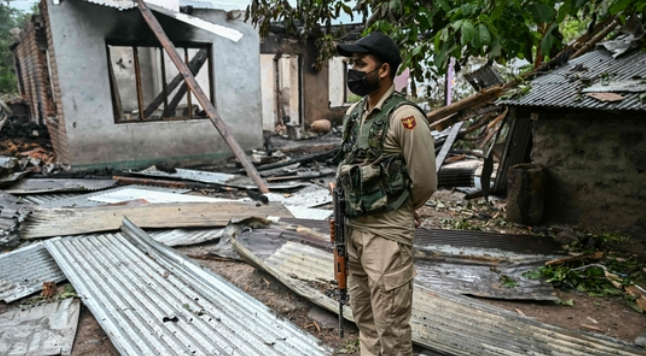
Early this Friday morning, Pakistan took things further by engaging in fierce shelling along the LoC in Poonch, Rajouri, Uri, and Chowkibal in Kupwara. In Uri, a civilian woman lost her life, and a number of residential houses suffered extensive damage. A number of houses in Chowkibal were likewise targeted. Local media paint a picture of panic where civilians are being relocated to safe areas in the midst of ongoing shelling.
Chief Minister Omar Abdullah stated that he was on his way to Jammu to take stock of the security situation. “Heading to Jammu now to take stock of the situation post last night’s botched Pakistani drone strike targeted at Jammu city & other areas of the division,” he tweeted on X, joining the widespread concern in the Union Territory.
Thursday morning had witnessed India launching pre-emptive attacks on Pakistani air defence installations, one of which in Lahore had been “neutralised.” In retaliation, Pakistan fired at least eight missiles later in the evening, targeting vital spots such as Satwari close to Jammu Airport, Samba, RS Pura, and Arnia. Due to India’s S-400 missile defence system and other intercept mechanisms, all the incoming threats were intercepted mid-air.
Massive explosions were witnessed in Jaisalmer, with a total blackout enforced in western Rajasthan’s border states. Blackouts were also enforced in parts of Punjab and Jammu and Kashmir as drones and planes from the other side of the border were seen.
India retaliated by sending kamikaze drones at key Pakistani military locations. The retaliatory attack, aimed at disabling Pakistani air defence capability, was a dramatic escalation of the standoff.
At the same time, the civil aviation ministry declared the closure of 24 airports for civilian use with effect from Thursday evening. Some of these are heavily used bases such as Srinagar, Chandigarh, Jaisalmer, and Shimla. The move reflects the increased threat perception along India’s western border.
Neighboring states of Pakistan, such as Punjab, Rajasthan, Gujarat, and Haryana, have also taken strict measures—closing schools, suspending leaves for police and administrative personnel, and increasing troop deployments in sensitive areas. The capital, Delhi, and eastern states such as West Bengal and Bihar, have also alerted their administrations, showing that the spillover effects of the standoff are being experienced across the country.
Global responses have started trickling in. American Secretary of State Marco Rubio had individual talks with Indian External Affairs Minister S. Jaishankar and Pakistani Prime Minister Shehbaz Sharif, appealing for restraint. In a statement, Rubio laid stress on de-escalation and took a direct shot at Pakistan by appealing specifically to restrain support to terror groups.
India holds steady, however. Diplomatic sources say Jaishankar communicated that India does not want to go further, but if attacked in its sovereignty or its citizens, India will choose to retaliate strongly. “Terrorism and cross-border hostility cannot be rewarded with silence,” he was quoted as saying.
Adding to the seriousness, U.S. President Donald Trump added that both countries need to “stop the tit-for-tat actions” and repeated that he was willing to act as a mediator “if asked.” But there is little suggestion that either nation is willing to accept third-party intervention at this point.
Defence Minister Rajnath Singh, at a meeting with leaders of all parties on Thursday, said that Indian military operations in the last 48 hours had killed more than 100 “hardcore terrorists and their handlers.” He emphasized that India would love to have peace but would never accept threats to its national security.
Indian public opinion has become more aggressive over the past few weeks, especially following the Pahalgam attack. Most people find Pakistan’s recent behavior provocative and unacceptable. Though the Indian government has not issued any official statement about possible future operations, military commentators believe that India is gearing up for a long time of increased readiness.
In border towns, families are seeking refuge in bunkers, schools have been closed, and supply lines have been cut off. Humanitarian agencies are starting to organize relief for civilians forced out of their homes by the continued shelling in Jammu and Kashmir.
Till Friday morning, the tensions are still sky-high, with the likelihood of more retaliatory strikes hanging in the air. Both armies are on the highest alert. The Indian government has reiterated its resolve to protect its territorial integrity, but the next few days will be pivotal in deciding whether or not the conflict abates—or escalates.
With ground-level intelligence operations stepped up, air defence systems activated, and international diplomatic avenues open, the area is at a perilous juncture. The world waits anxiously as two nuclear neighbours move dangerously close to direct confrontation.