
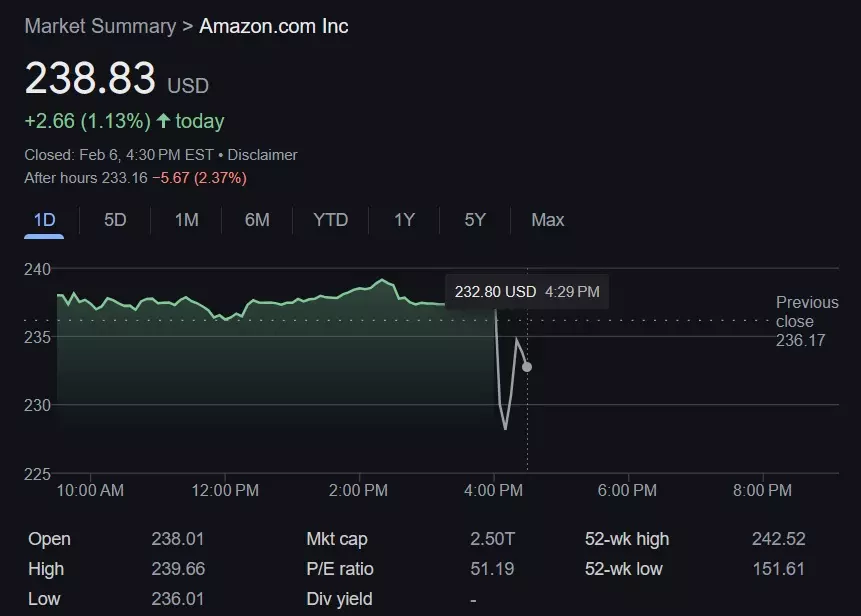
One of the biggest Internet companies in the world, Amazon (NASDAQ: AMZN), saw its stock dip 7.1% in afternoon trading after the firm posted disappointing sales results for the last quarter of the year, missing Wall Street’s estimates for revenue and operating income guidance for the next quarter. Its AWS (Amazon Web Services) segment was no exception as it failed to live up to investors’ expectations with its sales results, which further added to market’s reaction.
This article explores the reasons behind Amazon’s stock decline, the implications of its earnings report, and the broader market outlook. We will also examine Amazon’s current positioning in the cloud and e-commerce industries and answer some key frequently asked questions.
Understanding the Stock Decline
Disappointing Earnings Guidance
Amazon reported fourth-quarter earnings that, although solid, disappointed investors with lower-than-expected revenue and operating income guidance. Although the company beat analysts’ expectations on operating profit and EPS, investors were cautious about the future outlook of the company. The lackluster guidance raises concerns about slowing growth and profitability, which has led to a sell-off in the stock.
AWS Growth Concerns
AWS, part of Amazon’s cloud computing division and a significant segment of its revenue, grew at a slower pace than peers like Microsoft Azure and Google Cloud. Though AWS posted gains year over year, that wasn’t enough for investors looking for stronger results given the growth in demand for cloud services, which they believe correlates with the increasing usage of AI-related computing power.
E-Commerce Segment Uncertainty
Though its core e-commerce business did remarkably well, Amazon did exhibit a few vulnerabilities. One was third-party seller services. And then there have been trade wars and macroeconomic headwinds which raise more and more doubts on the profit-generating prowess of its e-retail arm.
Slight miss on the ad segment
Amazon’s advertising segment, another high-growth area, narrowly missed Wall Street estimates. Although the segment has been expanding rapidly and contributing significantly to Amazon’s bottom line, investors expected more robust numbers given the increasing competition in digital advertising from companies like Google and Meta.
Overall Market Sentiment
Amazon stock has been a bit volatile, with it experiencing several swings of more than 2.5% during the past year. But today’s decline is a market’s reaction to its guidance, not a fundamental change in its business long-term strategy. Investors are recalibrating their expectations on a note that may be overly optimistic since Amazon had such strong earnings performances last quarter.
Market Context and Long-Term Outlook
Historical Performance
Over the past year, Amazon has had several significant stock moves, including a 7.6% increase three months ago when it reported strong third-quarter earnings. This surge was driven by better-than-expected EPS and operating income results, reinforcing confidence in Amazon’s ability to improve margins.
Despite today’s drop, Amazon stock is still up 4% year-to-date and remains close to its 52-week high of $242.06. Investors who bought $1,000 worth of Amazon shares five years ago would now see their investment more than double to about $2,203.
Cloud and AI Growth Prospects
Amazon is preparing for significant increases in its offerings of cloud computing and artificial intelligence. The company itself has projected capital expenditures of $100 billion in 2025. Much of that investment is being directed toward strengthening AWS and AI services. That positioning reflects a strategy in which Amazon has placed confidence in AI and cloud computing as drivers of future successes, including e-commerce and advertising potential.
Despite short-term headwinds, Amazon’s e-commerce and advertising businesses continue to be major revenue contributors. The company is optimizing its logistics, expanding its third-party seller ecosystem, and using its Prime membership program to drive sales.
Is Now the Time to Buy Amazon Stock?
With the recent price decline, some investors could consider this an opportunity to buy. Amazon still dominates several industries with high growth potential, including cloud computing, AI, and e-commerce. The volatility in the stock price might be quite disturbing for a few, but long-term investors could see the recent decline as an opportunity to accumulate shares at a discounted price.

Frequently Asked Questions (FAQs)
What is the reason behind the drop in Amazon’s stock today?
The shares of Amazon plummeted 7.1% as the company reported lower-than-expected revenue and operating income for the next quarter. This aside, investors are also concerned that AWS’s growth is not as rapid as that of Microsoft and Google.
How does Amazon’s AWS compare to competitors?
AWS still leads in cloud computing but has stiff competition from Microsoft Azure and Google Cloud, which are growing faster. Amazon is investing more in AI and cloud services to maintain its position.
Is Amazon’s e-commerce business struggling?
Amazon’s e-commerce business remains healthy, with strength in both online and physical stores. However, the third-party seller services segment was weak, and ongoing trade uncertainties add a layer of risk.
Should I buy Amazon stock after the price drop?
Long-term investors might consider this decline an excellent buying opportunity as Amazon enjoys a robust market position and holds potential for further growth in the fields of cloud computing and AI. However, the decision will heavily depend on short-term traders on market volatility.
What is the long-term growth strategy of Amazon?
Amazon is concentrating on the growth of AWS and AI capabilities, growth in the advertising business, and optimization of its e-commerce operations. The capital expenditure plan by the company of $100 billion for 2025 points toward future growth.
Amazon stock fell today because investors are disappointed with earnings guidance, not because of a problem in its business model. These short-term concerns notwithstanding, Amazon continues to dominate multiple industries, including cloud computing, AI, e-commerce, and advertising. For a long-term investor, this downturn provides a window of opportunity to invest in a high-quality stock at a discount. This article is meant for readers to apply their research and consider their risk appetite before investing.