Despite better-than-expected sales, Dell Technologies (DELL) posted first-quarter fiscal results that were in line with Wall Street’s forecasts. But after the business gave unimpressive guidance, Dell’s shares dropped.
With $22.24 billion in sales for the quarter that ended on May 3, the Round Rock, Texas-based firm reported adjusted earnings of $1.27 per share. Based on $21.69 billion in revenue, analysts surveyed by FactSet predicted earnings per share of $1.27. Dell’s revenues rose 6% over the previous year, but its earnings decreased by 3%.
After six quarters of year-over-year losses in revenue, Dell saw sales gain this quarter. Dell’s Infrastructure Solutions Group, which sells networking, storage, and server equipment, recorded $9.2 billion in sales last year, a 22% rise. The business’s Client Solutions Group offers desktop and notebook PCs, recorded flat sales of $12 billion.
Dell’s stock fell from a record high in spite of these outcomes. Dell showed excellent execution and cash flow, with AI generating new growth, according to a news release from Chief Financial Officer Yvonne McGill.
Dell predicted adjusted earnings of $1.65 per share on $24 billion in sales for the current quarter, which is lower than the $1.88 per share analysts had predicted on $23.35 billion in sales. Dell predicted adjusted earnings per share for the entire fiscal year on revenues of $95.5 billion, which was just less than Wall Street’s forecast of $7.74 per share on $94.64 billion in sales.
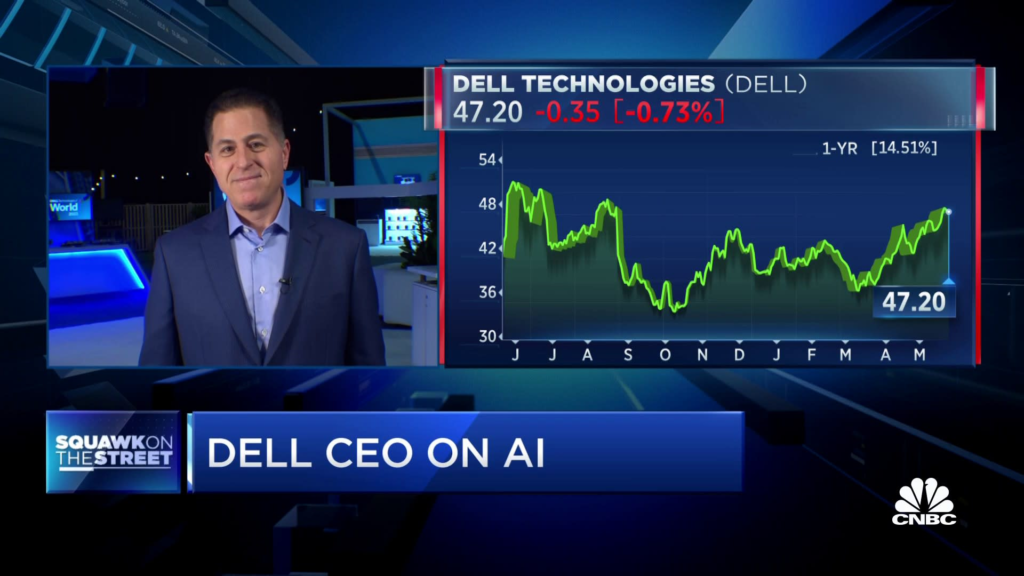
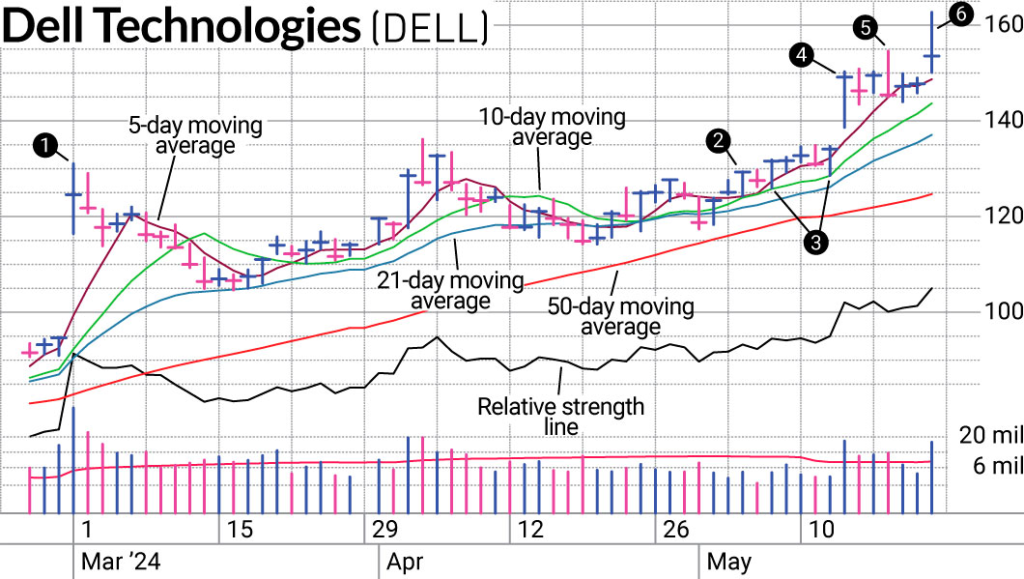
The price of Dell stock fell 17.6% to 140 in after-hours trading. Dell’s shares fell 5.2% during Thursday’s regular session, ending at 169.91. On Wednesday, the stock reached a new high of 179.70 following a price-target increase from BofA Securities. BofA analyst Wamsi Mohan predicts that Dell will profit from the growth of data centers for generative AI applications.
During the May 20–23 Dell Technologies World conference, the company unveiled new AI servers, AI PCs, and all-flash storage along with network design. Additionally, it declared a wider partnership with Nvidia, a manufacturer of AI chips (NVDA).
According to Chief Operating Officer Jeff Clarke, record sales of servers and networking equipment were the main factor in Dell’s higher-than-expected revenue. He underlined that no business is in a better position than Dell to bring AI to the enterprise. Dell’s AI-optimized server orders increased sequentially to $2.6 billion, and its backlog grew by more than 30% to $3.8 billion.
In the meantime, rival company HP (HPQ) revealed better-than-expected results for the second quarter of its fiscal year, which concluded on April 30. Analysts had predicted that HP would make 81 cents per share on sales of $12.61 billion, but the company actually made an adjusted 82 cents per share on $12.8 billion. HP’s earnings increased by 4% on an annual basis, despite a nearly 1% decline in sales. HP has seen a decline in sales for eight quarters running.
HP’s stock closed up 17% to 38.36 on Thursday after breaking out of a 46-week consolidation pattern at a buy target of 33.90. Dell is ranked third while HP is ranked fourth out of 15 stocks in the industry group for computer hardware and peripherals, according to IBD Stock Checkup.