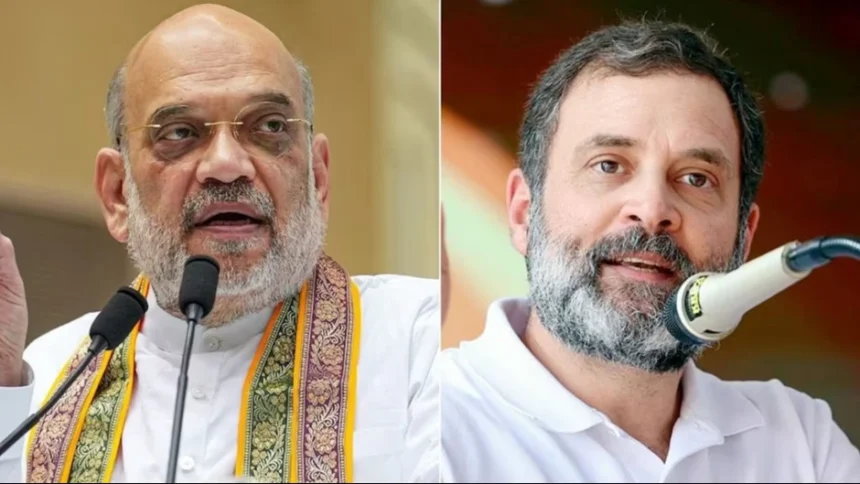
Union Home Minister Amit Shah recently launched a scathing critique of Congress leader Rahul Gandhi, accusing him of “hurting the nation’s sentiments” with his remarks about India’s reservation system during a trip to the United States. Rahul Gandhi, while addressing students at Georgetown University, suggested that the Congress party would reconsider the system of reservations when India becomes a “fair place.” This statement provoked an immediate and strong reaction from Shah, who accused Gandhi of questioning one of India’s most sensitive sociopolitical issues.
Gandhi’s Remarks on Reservation
During his discussion at Georgetown, Rahul Gandhi remarked on the inequities in India and implied that the reservation system, which provides quotas for historically marginalized communities in education and employment, could be reevaluated when the nation achieves greater fairness. Gandhi’s comments sparked significant controversy, as they touched upon a policy that has long been a cornerstone of India’s efforts to address caste-based discrimination and social inequality. His critics interpreted the remarks as undermining the very system that has allowed disadvantaged communities better access to opportunities.
Amit Shah’s Response
Amit Shah, representing the ruling Bharatiya Janata Party (BJP), condemned Gandhi’s statement, alleging that it revealed the Congress party’s true “anti-reservation face.” Shah stated that the BJP remains firmly committed to the reservation system and would never allow it to be abolished. He declared, “As long as the BJP is in power, no one can abolish reservation or compromise the nation’s security.”
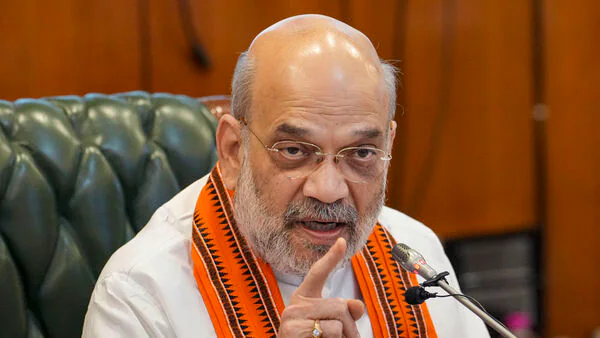
Shah accused Gandhi of repeatedly aligning with divisive forces and making statements that undermine national unity. He further charged that Gandhi’s remarks reflect a long-standing pattern of the Congress party’s alleged opposition to affirmative action, which benefits marginalized communities. According to Shah, the Congress has consistently used tactics that foster division along religious, regional, and linguistic lines, and this latest remark fits into that broader strategy.
Accusations of Anti-Nationalism
The Union Home Minister’s critique went beyond the topic of reservations. He also accused Rahul Gandhi of making “anti-national” statements during his visits abroad, claiming that Gandhi has a habit of criticizing India on international platforms. According to Shah, Gandhi’s actions serve to weaken the country’s reputation and stability, particularly by airing domestic grievances in foreign countries. Shah specifically mentioned previous instances, such as Gandhi’s support for the Jammu and Kashmir National Conference, where he believes the Congress leader has taken anti-India stances.
Shah’s fiery response also highlighted a broader political battle between the BJP and Congress, centered around key issues of national identity, social equity, and the role of affirmative action in India’s democracy. By accusing Gandhi of questioning the reservation system, Shah painted the Congress leader as being out of touch with the needs of India’s historically disadvantaged populations.
A Political Flashpoint
This exchange between Amit Shah and Rahul Gandhi is the latest in an ongoing rivalry between the BJP and Congress, with both sides trying to position themselves as the true defenders of Indian values. For the BJP, reservations represent an essential tool in fostering social justice and equity. Gandhi’s remarks, which were seen as a potential rollback of these efforts, have given the BJP further ammunition to accuse Congress of undermining India’s welfare policies for marginalized communities.
On the other hand, Rahul Gandhi and the Congress have long been critical of the BJP’s handling of social issues, accusing the ruling party of fostering inequality and using divisive politics to win votes. Gandhi’s remarks may have been an attempt to highlight what he sees as persistent inequities in Indian society, though they have been largely interpreted as an attack on affirmative action.
The controversy surrounding Rahul Gandhi’s comments on reservation underscores the political sensitivity of the issue in India. Amit Shah’s swift condemnation reflects the ruling party’s efforts to position itself as the protector of marginalized communities while casting doubt on the Congress party’s commitment to social justice. As both parties gear up for future elections, issues like reservation and national unity are likely to remain central to the political debate, with each side trying to shape public opinion in their favor.
This incident is a reminder of how deeply entrenched the issue of caste and reservation is in India’s political landscape and how any discussion on these matters can quickly become a flashpoint for national controversy.